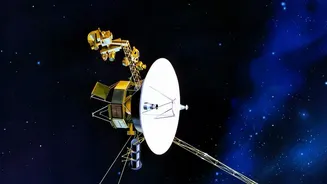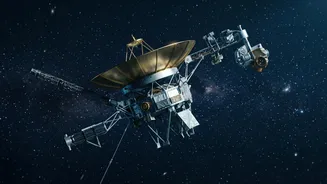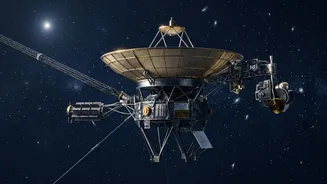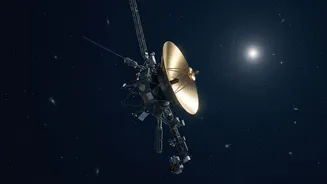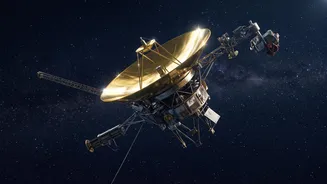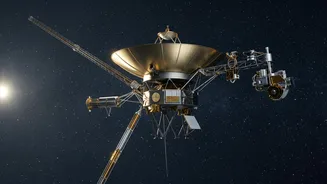



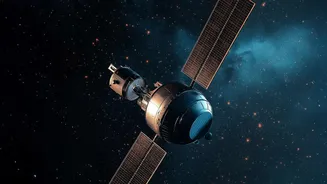
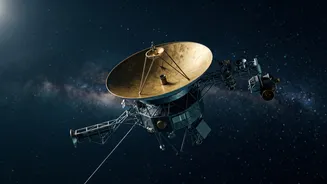
Nearly 50 years after it left Earth, humanity’s most distant emissary is about to cross an invisible, yet monumental, line. On November 18, 2026, NASA’s Voyager 1 will be one light-day away, a testament to 1970s engineering and a new chapter in exploration.
What is a Light-Day?
We often hear about 'light-years' when discussing cosmic distances, and a light-day is a more immediate, yet still mind-boggling, version of that concept. It is the distance light, the fastest thing in the universe, travels in 24 hours. That equates to approximately 25.9 billion kilometres. For context, light takes about 1.3 seconds to get from Earth to the Moon and a little over eight minutes to travel from the Sun to us. When Voyager 1 reaches this milestone, a radio signal sent from NASA’s Deep Space Network will take a full day to reach the probe, and another day for a response to return. A simple 'hello' and its reply will become a 48-hour conversation.
A Journey Almost 50 Years in the Making
Launched on September 5, 1977, Voyager 1’s primary mission was to conduct an unprecedented 'Grand Tour' of the outer planets, taking advantage of a rare planetary alignment. Its trajectory prioritised a fast path to Jupiter and Saturn. During its flybys in 1979 and 1980, the spacecraft made stunning discoveries, including active volcanoes on Jupiter's moon Io—the first ever found beyond Earth—and the intricate, complex nature of Saturn’s rings. It also revealed that Saturn's largest moon, Titan, was shrouded in a thick nitrogen-rich atmosphere. After its encounter with Saturn, a gravity assist flung it northward, out of the plane of the planets and onto its current path toward the stars.
Entering Interstellar Space
The mission didn't end after the planets. In August 2012, Voyager 1 made history by becoming the first human-made object to cross the heliopause—the boundary where the Sun's stream of charged particles gives way to the interstellar medium. It had officially entered the space between stars. Its instruments provided the first-ever direct measurements of this mysterious region, detecting the density of the interstellar medium and the intensity of cosmic rays beyond our Sun's protective bubble. Its twin, Voyager 2, which took a longer route to visit Uranus and Neptune, joined it in interstellar space in 2018.
The Challenge of an Aging Explorer
Keeping a nearly 50-year old spacecraft operating with 1970s technology is a monumental feat of engineering. Power is supplied by radioisotope thermoelectric generators (RTGs), which have been steadily losing wattage over the decades. To conserve energy, NASA engineers have been strategically shutting down instruments and heaters. Recent technical glitches, including a period in late 2023 when the probe sent back garbled data, highlight the difficulties of troubleshooting a machine billions of kilometres away. Despite these challenges, engineers have found clever ways to extend its life, ensuring it can continue to send back valuable science for as long as possible.
A New Chapter for Humanity's Emissary
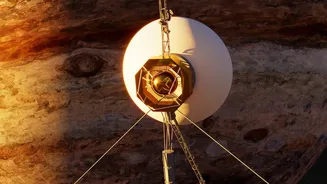
Reaching the one light day mark is more than just a record ; it 's a profound milestone in humanity 's journey into the cosmos . While its power is expected to run out sometime in the $2030$s , silencing its radio for good , Voyager $1$ ' s journey will continue . It is currently travelling at about $61 ,000$ kilometres per hour toward a star named Gliese $445$ , though it won ' t get close for another $40 ,000$ years . Even after it goes quiet , the spacecraft will carry its Golden Record — a gold plated copper disc containing sounds and images of life on Earth — silently through the void . This light day marker serves as a poignant reminder of both the vastness of space and the incredible reach of human curiosity .