






An Earth-Like, Alien World
Titan is a world of incredible scientific interest. It is the only moon in our solar system with a dense atmosphere, primarily composed of nitrogen, much like Earth's. However, its environment is profoundly alien. With surface temperatures around -179°C,
water ice is as hard as rock, and rivers, lakes, and seas are filled with liquid methane and ethane. This creates a landscape with dunes made of organic sand grains and a weather cycle involving methane rain. Scientists are fascinated by Titan because its complex carbon-rich chemistry is thought to be similar to that of early Earth, offering a unique chance to study the building blocks of life. The mission aims to investigate prebiotic chemistry and the moon's potential habitability.
The Physics of Flight on Titan
The decision to use a flying vehicle is rooted in Titan's unique physical properties. Flying on Titan is significantly easier than on Earth. This is due to a perfect combination of two factors: a thick atmosphere and low gravity. Titan's atmosphere is about four times denser at the surface than Earth's, providing more substance for rotors to push against and generate lift. At the same time, its gravity is only about one-seventh of Earth's, meaning any object weighs far less. This combination makes powered flight incredibly efficient, allowing a heavy craft like Dragonfly to get airborne and travel long distances with relatively little energy.
Introducing Dragonfly: A Nuclear-Powered Drone
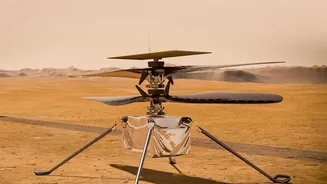
The Dragonfly spacecraft is a rotorcraft-lander, essentially a large, car-sized drone with eight rotors. This dual-quadcopter design allows for vertical takeoffs and landings, giving it the ability to operate like a helicopter. Unlike solar-powered missions, Dragonfly will be powered by a Multi-Mission Radioisotope Thermoelectric Generator (MMRTG), the same type of nuclear power source used by the Curiosity rover on Mars. This is necessary because Titan's hazy atmosphere blocks most sunlight. The mission, scheduled to launch in July 2028 and arrive in 2034, is designed to be highly mobile and autonomous.
Mobility a Rover Could Only Dream Of
A traditional wheeled rover on Titan would be severely limited. It would struggle with the complex terrain of organic sand dunes and the shores of methane lakes. A flying vehicle, however, can simply leap over these obstacles. This mobility is Dragonfly's greatest advantage. In a single flight lasting just tens of minutes, it can cover several kilometers—a distance that would take a Mars rover an entire day or more. Over its planned mission, Dragonfly is expected to travel hundreds of kilometers, hopping between dozens of diverse geological sites. This allows scientists to sample a much wider range of materials and environments than would ever be possible with a stationary lander or a slow-moving rover.
A Mission to Sample and Discover
Dragonfly is not just a flight vehicle; it is a sophisticated mobile laboratory. Its primary goal is to study how far prebiotic chemistry has progressed on Titan. The rotorcraft is equipped with a suite of scientific instruments, including drills to collect surface samples and a mass spectrometer to analyze their chemical composition. By visiting different locations, such as organic dunes and an impact crater where liquid water may have once mixed with organic materials, scientists hope to find clues about the origins of life. The mission will investigate the habitability of Titan's environment and even search for chemical signatures that might indicate past or present life.