
Start with Your Story
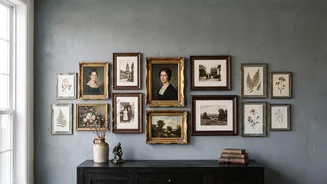
The most compelling gallery walls feel collected over time because they are deeply personal. Before you think about layout or frames, gather your treasures. This is your chance to combine sentimental family photos, postcards from a memorable trip, and
that one quirky painting you couldn't leave behind at a flea market. The goal is to choose pieces that resonate with you, separating their emotional importance from their size or visual weight. A small, meaningful photograph can be just as powerful as a large painting. By focusing on your personal narrative first, the collection will naturally develop a cohesive point of view.
The Thrill of the Vintage Hunt
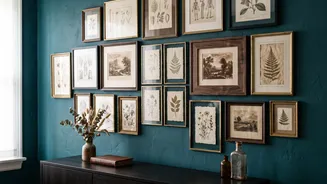
Building a vintage collection doesn't require a large budget. Flea markets, thrift stores, and online marketplaces like Etsy and eBay are goldmines for affordable and original art. Look for pieces with character: small oil paintings, botanical prints, or framed mirrors with a bit of patina. Digital archives from museums and sellers like Vintage Supply offer high-resolution downloads for as little as a few dollars, which you can then have printed to your desired size. Don't be afraid to buy a piece just for its ornate frame; you can always replace the art inside. This slow and steady process of collecting makes the final gallery wall feel authentic and layered.
Create Harmony with a Common Thread
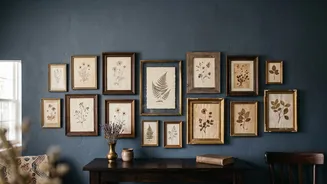
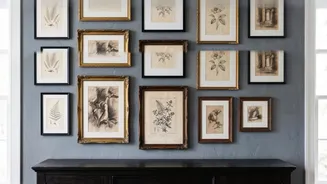
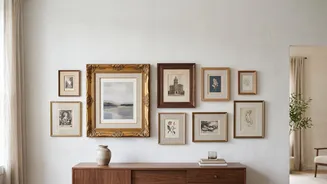
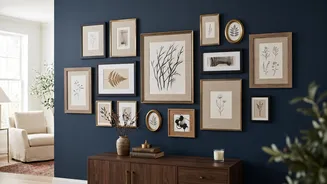
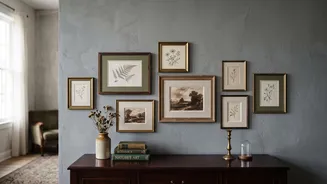
To prevent your eclectic mix from looking chaotic, establish a unifying element. This doesn't mean everything has to match. Instead, create cohesion by repeating one or two details throughout the display. You could stick to a limited colour palette, such as earthy tones or black and white. Alternatively, repeat a frame finish, like warm wood or antique gold, across several pieces. Using a consistent mat colour, such as cream or off-white, can also tie disparate images together, making a casual photo feel as intentional as a professional print. This common thread helps the eye move smoothly across the wall, making the arrangement feel curated rather than cluttered.
Mastering the Small-Space Layout
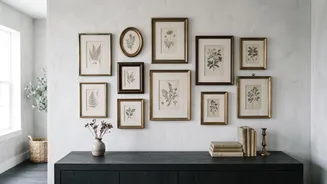
In a compact room, every design choice matters. Instead of spreading art across a wall, think vertically. A tall, narrow arrangement draws the eye upward and creates an illusion of height. When hanging art above furniture like a sofa or bed, follow the two-thirds rule: the width of your gallery should be about two-thirds the width of the furniture below it. To avoid a cluttered look, leave 'breathing room' or negative space around the entire arrangement. For a foolproof planning method, trace each frame onto wrapping paper, cut out the templates, and tape them to the wall. This allows you to perfect the layout before making a single hole, ensuring the spacing—typically 2-3 inches between frames—is consistent.
Mix, Layer, and Add Dimension
The most dynamic gallery walls often include more than just framed prints. Incorporating different textures and shapes adds depth and personality. Consider mixing in a small, decorative mirror to reflect light, a woven tray for texture, or a piece of framed textile art. These three-dimensional objects break up the flatness of a wall of frames and create a more engaging display. Layering frames on a narrow picture ledge is another great option, especially for renters, as it allows for flexibility and requires minimal holes in the wall. The key is moderation; one or two dimensional pieces are often enough to add interest without overwhelming the collection.