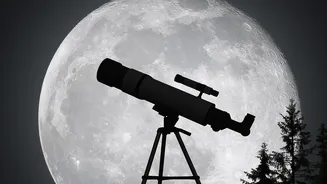




Tired of seeing only a handful of stars from your city window? India's high-altitude mountain locations offer a breathtaking escape into the cosmos, where clear, dark skies reveal the universe in all its glory. Here’s why mountains matter.
The Science of Mountain Stargazing
Before we journey
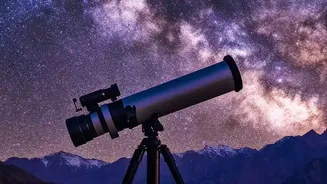
to the destinations, it’s important to understand why mountains provide such a superior celestial show. The magic lies in a few key factors. Firstly, high altitude places you above a significant portion of the Earth's atmosphere. This thinner air means less dust, moisture, and pollution to scatter light and obscure your view. The result is a more transparent sky where stars appear sharper and brighter, with less of the 'twinkling' caused by atmospheric turbulence. Secondly, mountain locations are typically remote and sparsely populated, meaning they suffer from minimal light pollution. This man-made glow from cities can wash out all but the brightest stars. In the protected darkness of the mountains, faint objects like the Milky Way, distant galaxies, and nebulae become visible to the naked eye. A dry climate, common in high-altitude desert regions, further reduces atmospheric moisture, ensuring crisp, clear nights.
Hanle, Ladakh: India’s First Dark Sky Reserve
Topping any list of premier stargazing sites is Hanle in Ladakh, officially designated as India's first Dark Sky Reserve in 2022. Sitting at a staggering altitude of 4,500 metres (14,764 feet) on the Changthang Plateau, Hanle offers some of the darkest skies on the planet, rated as Bortle Class 1. This extreme altitude and its location in a rain-shadow desert result in over 250 clear nights per year with exceptionally dry air. The area is home to the Indian Astronomical Observatory, a testament to its world-class observing conditions. For visitors, this means the Milky Way is not just visible but can be so bright it casts a faint shadow. Local communities have embraced astrotourism, with villagers trained as 'Astronomy Ambassadors' who guide visitors through the cosmos using telescopes at homestays. Visiting Hanle requires careful planning, including obtaining an Inner Line Permit and acclimatising properly to the high altitude for several days in Leh before proceeding.
Spiti Valley, Himachal Pradesh: A High-Altitude Desert Canvas
Often called a 'cold desert', Spiti Valley in Himachal Pradesh is another jewel for astronomers. With altitudes averaging 3,800 to 4,500 metres, Spiti shares many of the advantages of Ladakh: high elevation, minimal light pollution, and a dry climate that ensures cloud-free nights, especially from June to October. Villages like Kaza, Kibber, Langza, and Komic serve as excellent bases for stargazers. These remote settlements turn into natural observatories after sunset, offering pristine Bortle Class 2 skies. The landscape itself, with its ancient monasteries and dramatic peaks, provides a stunning foreground for astrophotography. On a clear, moonless night here, the sheer number of stars can be overwhelming, and the structure of the Milky Way is easily discernible. While the experience is profound, visitors must be prepared for the cold, as night temperatures can drop close to freezing even in summer.
Kausani, Uttarakhand: Accessible Himalayan Views
For those seeking a Himalayan stargazing experience without the extreme logistics of Ladakh or Spiti, Kausani in Uttarakhand is an excellent choice. Situated at an altitude of about 1,890 metres (6,200 feet), it offers a fantastic vantage point away from major city lights. Kausani is famous for its panoramic views of Himalayan peaks like Nanda Devi and Trishul, which create a spectacular backdrop for the night sky. While not as dark as Hanle or Spiti, the skies here are significantly clearer than in the plains, allowing for great views of constellations and planets. The best viewing conditions are typically from October to March, when the poststmonsoon air is crisp and clear. Several hotels and local operators in Kausani offer guided stargazing sessions, sometimes with telescopes, making it a beginnerfriendly destination.
Devasthal,
Nainital:
A Scientific Hub with Starry Views
Near Nainital lies Devasthal,
whose name means 'abode of the gods'. At an altitude of $2$,$450 metres,
this peak is home to a major astronomical site managed by the Aryabhatta Research Institute of Observational Sciences (ARIES). It houses some of Asia's largest and most advanced telescopes,
including the $3$.$6m Devasthal Optical Telescope and the $4m International Liquid Mirror Telescope.
While access to the research telescopes themselves is restricted,
the location's selection as a prime observatory confirms its excellent atmospheric conditions and dark skies.
The surrounding area,
away from the lights of Nainital town,
provides a great opportunity for amateur stargazing.
ARIES also operates a Science Centre at its Manora Peak campus near Nainital,
which is open to the public and offers evening stargazing sessions,
making it an educational and inspiring stop for aspiring astronomers.