



What Is Space Weather and Why Does It Matter?
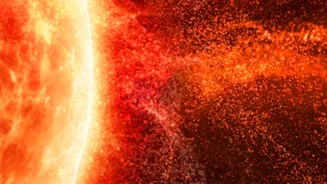
Space weather refers to the changing conditions in space driven by the Sun's activity. This includes phenomena like solar flares, which are intense bursts of radiation, and coronal mass ejections (CMEs), which are massive clouds of plasma and magnetic
fields hurled into space. While Earth's magnetic field protects us from the worst of it, severe solar storms can have a significant impact. They can disrupt and damage satellites, interfere with GPS and radio communications, and even cause widespread power outages by inducing damaging currents in electrical grids. In our increasingly tech-dependent world, the potential economic and societal cost of a major space weather event is enormous, making accurate forecasting not just a scientific curiosity but a global necessity.
The View from Earth: Strengths of Ground Telescopes
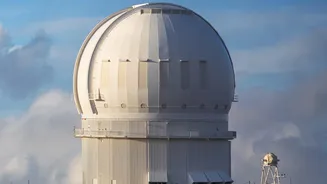
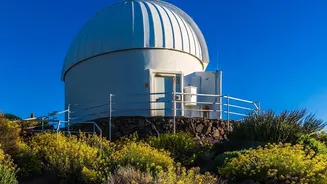
Ground-based solar observatories are the foundation of our solar monitoring capabilities. Facilities like the National Science Foundation's Daniel K. Inouye Solar Telescope in Hawaii, the world's largest, can capture incredibly detailed images of the Sun's surface. Their strength lies in high-resolution, high-precision observations of specific solar features. They can track the evolution of sunspot groups, where volatile magnetic energy is stored, and measure the fine details of the Sun's lower atmosphere. Networks of ground instruments, such as GONG (Global Oscillation Network Group), provide continuous, 24/7 coverage of the Sun by passing the baton from one observatory to the next as the Earth rotates. This constant vigilance is crucial for spotting the early signs of a potentially disruptive solar event.
The View from Space: An Uninterrupted Perspective
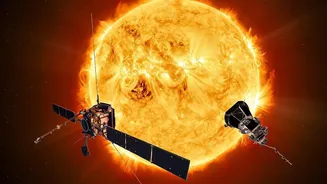
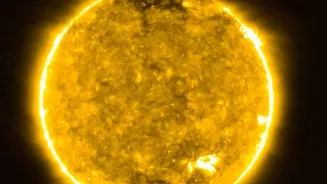
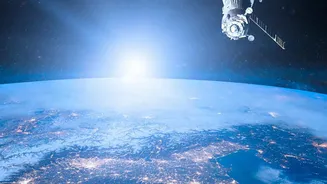
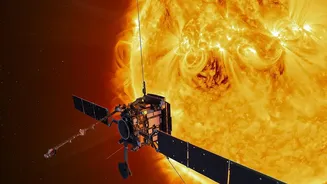
While ground telescopes are powerful, they are limited by Earth's atmosphere, which absorbs many wavelengths of light, and by the day/night cycle. Space agencies like NASA and the European Space Agency (ESA) operate a fleet of solar observatories to overcome these limitations. Missions such as the Solar Dynamics Observatory (SDO) and the Solar and Heliospheric Observatory (SOHO) enjoy an uninterrupted, unfiltered view of the Sun. They can see the Sun in wavelengths, like extreme ultraviolet, that are invisible from the ground, giving a complete picture of the solar atmosphere from the surface to the outer corona. This allows them to see CMEs as they erupt and track their path through space, which is impossible from Earth's surface.
The Power of Synergy: Combining Two Views
Neither ground nor space observatories alone can provide the complete picture needed for accurate forecasting. True predictive power comes from combining their unique data. Ground-based telescopes provide the detailed context of what's happening on the solar surface—the 'cause'. They can see the build-up of magnetic energy in an active region. Meanwhile, space-based observatories see the 'effect'—the resulting CME or flare erupting into space. By feeding data from both sources into sophisticated computer models, scientists can more accurately predict if a CME is heading toward Earth, when it will arrive, and how strong its impact might be. This synergy is a classic case of the whole being greater than the sum of its parts.
India’s Growing Role in Solar Observation
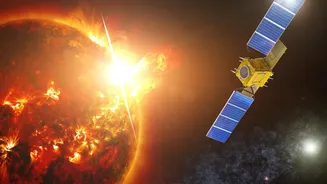
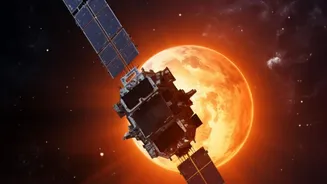
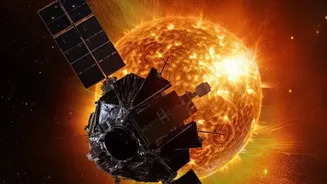
India has become a key player in this global effort. The Indian Space Research Organisation (ISRO) has advanced the nation's capabilities with missions like Aditya-L1, its first dedicated space-based solar observatory. Positioned at Lagrange Point 1 (L1), 1.5 million kilometers from Earth, Aditya-L1 has a continuous view of the Sun and can provide early warnings of solar events. This vital space data is integrated with information from India's extensive network of ground-based observatories, including the Udaipur Solar Observatory. This combined data pipeline is crucial for developing India's own space weather prediction programs, contributing to global resilience and protecting the nation's critical infrastructure.