




A New Cosmic Surveyor
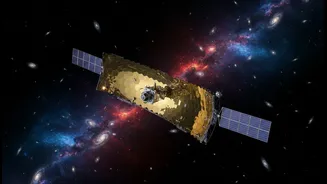
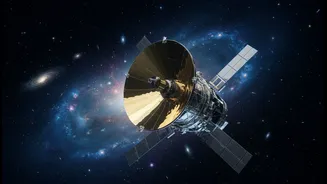
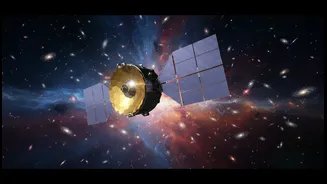
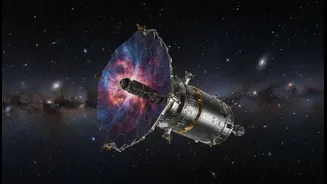
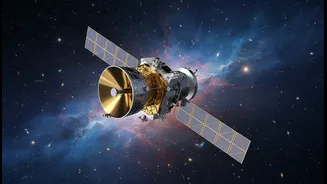
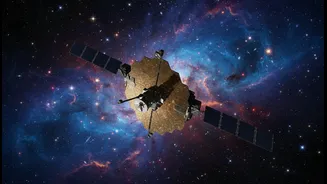
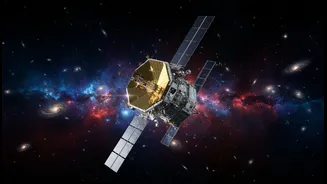
Meet the Nancy Grace Roman Space Telescope, NASA's next great observatory. Named after the agency's first chief of astronomy, often called the “Mother of Hubble,” Roman is engineered for a very different task than its famous predecessors. While the Hubble and
James Webb space telescopes excel at taking deep, detailed portraits of specific cosmic targets, Roman is built for panoramic photography. Its mission is to conduct vast surveys of the sky, capturing billions of stars and millions of galaxies to tackle some of the biggest questions in astronomy. With a primary mirror the same size as Hubble's—2.4 meters in diameter—it will deliver images with the same stunning sharpness but over a much larger area. This unique capability will help scientists study the mysterious forces of dark energy and dark matter, and discover thousands of new planets outside our solar system.
The Power of a Wider View
The secret to Roman's incredible survey speed is its Wide Field Instrument (WFI). This 300-megapixel infrared camera gives the telescope a field of view at least 100 times larger than Hubble’s main infrared camera. To put that in perspective, where Hubble would need to take hundreds of individual snapshots to create a mosaic of the Andromeda galaxy, Roman could capture the entire galaxy in just two. This leap in efficiency is transformative. Scientists estimate that Roman will be able to map over 50 times more sky in its five-year primary mission than Hubble has in over three decades. This wide-angle vision allows the telescope to not only see more of the universe at once but also to repeatedly scan the same patches of sky, creating time-lapse movies that can reveal transient events like exploding stars or the subtle brightening caused by a planet passing in front of a distant star.
Hunting for Dark Energy and New Worlds
Roman has two primary scientific goals. The first is to investigate dark energy, the enigmatic force causing the universe's expansion to accelerate. By mapping the distribution of millions of galaxies and observing distant stellar explosions called Type Ia supernovae, Roman will help astronomers understand how dark energy has shaped the cosmos over time. The second major goal is to conduct a census of exoplanets. Roman will use a technique called gravitational microlensing, where the gravity of a foreground star or planet bends and magnifies the light from a background star. This method is sensitive enough to find planets with masses even smaller than Earth's and those far from their host star. Projections suggest Roman could find around 100,000 new exoplanets, potentially more than all other telescopes combined have found to date.
A Deluge of Cosmic Data
A telescope this powerful will generate an astronomical amount of information. During its mission, Roman is expected to produce a data archive of roughly 20,000 terabytes. This massive volume of data presents both a challenge and an incredible opportunity. To manage the flow, NASA is preparing cloud-based platforms that will allow scientists from around the world to access and analyze the data without needing to download petabytes to their local computers. All of Roman's data will be publicly available immediately, with no proprietary period, ensuring that the entire scientific community can dig into its discoveries from day one. This open-access approach will fuel research across all areas of astrophysics for decades, from studies of our own solar system to the evolution of the most distant galaxies.
A Complement to Hubble and Webb
Roman is not a replacement for Hubble or Webb but a powerful new partner in cosmic exploration. Its strength lies in its survey capability, quickly identifying areas of interest and creating vast catalogs of objects. Hubble and Webb can then perform deep, focused follow-up observations on the most compelling targets Roman discovers. For instance, Roman might discover thousands of new planets, and Webb could then study the atmospheres of a select few to search for signs of habitability. Together, these observatories represent a multi-faceted approach to understanding the universe—Roman provides the wide-angle map, while its companions provide the detailed zoom.