


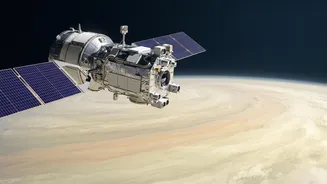
A Mission to Earth’s Hostile Sibling
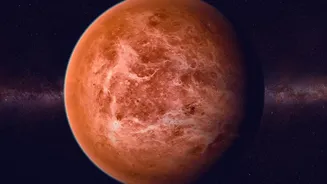
Venus may be similar to Earth in size and mass, but its environment is one of the most hostile in the solar system. Its surface temperature is a staggering 467 degrees Celsius, hot enough to melt lead, and the atmospheric pressure is over 90 times that
of Earth's. Blanketing the entire planet is a thick, opaque layer of clouds made not of water, but of corrosive sulfuric acid. For scientists, this hellish landscape holds the key to a vital question: why did two planets that started so similarly evolve so differently? Understanding Venus's runaway greenhouse effect could provide critical insights into Earth’s own climate future, making ISRO’s Shukrayaan-1 mission not just a journey of exploration, but one of profound relevance.
Shukrayaan-1: India’s Venusian Explorer
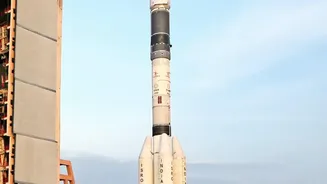
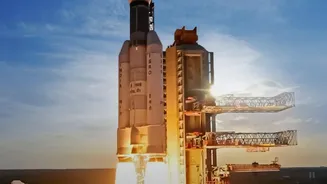
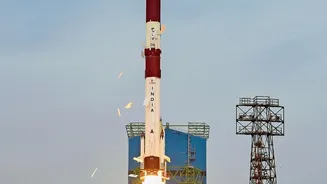
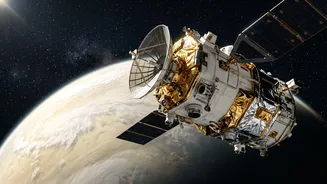
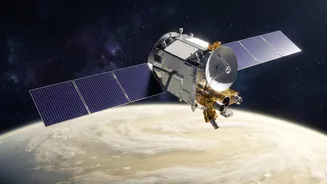
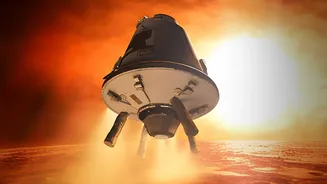
Following the monumental successes of the Chandrayaan moon missions and the Mangalyaan Mars orbiter, Shukrayaan-1 is ISRO’s next major leap in planetary science. Formally approved in September 2024 with a launch scheduled for March 2028, the mission will send a 2,500 kg orbiter on a 112-day journey to Venus. Once it arrives, the spacecraft will use a clever technique called aerobraking—dipping into the upper atmosphere to slow down—to settle into a stable science orbit. From this vantage point, it will spend four years studying the planet’s surface, subsurface, and notoriously complex atmosphere.
Peering Through the Toxic Veil
The sulfuric acid clouds are Shukrayaan's primary target. These clouds are so thick they permanently hide the Venusian surface from view in visible light. They are also central to the planet's extreme climate. Shukrayaan will be equipped with a suite of custom-designed instruments to finally see what lies beneath and within these hazardous layers. A key instrument is the Venus S-Band Synthetic Aperture Radar (VSAR), a powerful radar system that can pierce the cloud cover to map the surface with four times the resolution of NASA's previous Magellan mission. This will allow scientists to search for active volcanoes and other geological features. Several other specialized instruments, including a Cloud Monitoring Camera (VCMC) and a thermal camera, will study the clouds themselves—their structure, composition, and the mysterious lightning that flashes within them.
A Groundbreaking Toolkit of Sensors
Beyond just imaging the surface, Shukrayaan will be the first mission ever to probe beneath it. It carries a ground-penetrating radar, an unprecedented tool for studying the shallow subsurface of Venus and understanding its stratigraphy. The mission’s payload of around 19 instruments also includes significant international collaboration. An instrument co-developed with Russia and France, known as VIRAL, will analyse atmospheric gases. Meanwhile, a Swedish-Indian instrument called VISWAS will study how the solar wind interacts with the planet’s ionosphere, helping to explain how Venus lost its water. This comprehensive suite of sensors is designed to answer fundamental questions about the planet’s geology and atmospheric super-rotation.
Unlocking Venusian Secrets, Informing Earth’s Future
By deploying these custom-built tools, ISRO aims to solve some of the biggest puzzles about our neighbouring planet. Is Venus still geologically active? How did it transform into a scorching greenhouse world? And could life, in some form, exist in the more temperate layers of its acidic clouds? Recent research has shown that the building blocks of proteins can remain stable in concentrated sulfuric acid, making the search for biosignatures more compelling than ever. As Shukrayaan prepares for its journey, it represents a new chapter for Indian space exploration. The mission will join a renewed global interest in Venus, with NASA and the European Space Agency also planning missions around the same time. A successful mission will not only cement India’s position as a major player in interplanetary exploration but also provide data that could be vital for understanding the long-term future of our own planet.