




A New View of Creation
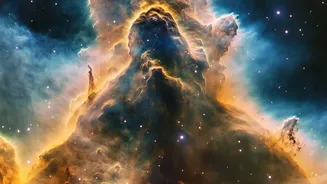
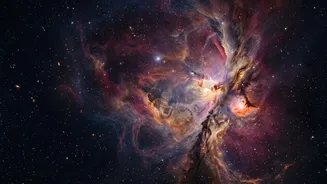
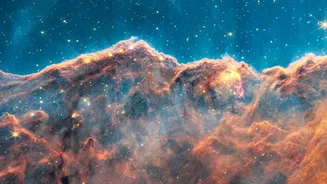
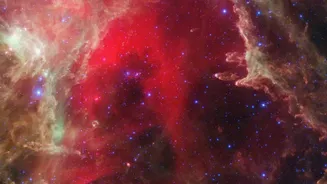
The latest images from the JWST offer an unparalleled glimpse into stellar nurseries, the vast, dense clouds of gas and dust where stars are born. One of the most breathtaking recent views is of the Carina Nebula, a massive star-forming region located
about 7,500 light-years from Earth. Within it, features nicknamed the 'Cosmic Cliffs' and the 'Treasure Chest' showcase regions where intense radiation from massive young stars is carving out cavities in the surrounding gas, triggering the formation of new stars. These images reveal emerging protostars—infant stars still gathering mass from their parent cloud—that were previously completely hidden from view.
The Power of Infrared Light
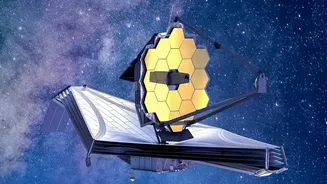
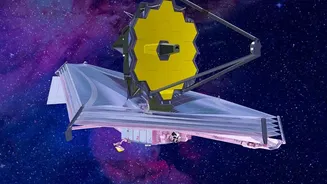
So, how is Webb able to see what other powerful telescopes, like Hubble, could not? The secret is its ability to see in infrared light. Stellar nurseries are incredibly dense, and the thick clouds of dust and gas act like a shroud, blocking visible light. This makes it impossible to see the earliest stages of star formation with conventional telescopes. However, infrared light, which has longer wavelengths, can penetrate these dusty cocoons. This allows the JWST to peer inside and observe the processes that lead to the birth of stars and planets, revealing details that were once purely theoretical. The telescope's extreme sensitivity captures the faint heat glow of dust warmed by newborn stars.
The Anatomy of a New Star
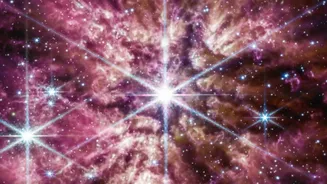
Looking at these images is like witnessing the blueprint of a solar system. Stars form when dense pockets within these molecular clouds collapse under their own gravity. This collapsing core, known as a protostar, heats up as it pulls in more gas and dust. In the JWST's images, these youngest sources often appear as red dots in the darkest, most dust-rich areas. As these baby stars grow, they don't just consume material; they also blast out powerful jets of gas and energy. These jets, sometimes called protostellar outflows, slam into the surrounding gas, causing it to glow and creating spectacular structures that help clear away the star's birth cocoon. Eventually, the remaining material around the star settles into a rotating disk, the very place where planets may one day form.
Why These Nurseries Matter
Studying these stellar nurseries is about more than just capturing beautiful cosmic landscapes. It's fundamental to understanding our own origins. The processes happening in places like the Orion Nebula and the Tarantula Nebula are similar to how our own Sun and solar system were formed billions of years ago. By observing thousands of never-before-seen young stars, scientists can test and refine their theories on star formation and, by extension, galaxy evolution. Some of these regions are chemically similar to those from the universe's 'cosmic noon,' a period when star formation was at its peak, providing a window into the past. Ultimately, by watching other stars come into existence, we are learning more about the conditions that made life on Earth possible.