

The Old Way: Radio Wave Woes
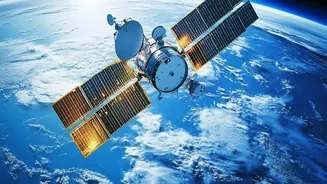
For as long as humanity has sent probes and rovers into the solar system, we have relied on radio frequency (RF) communications to get data back. Think of it as the original interstellar dial-up. While reliable, RF systems have major limitations. They
spread out over vast distances, meaning the signal gets weaker and can carry less information. As our scientific instruments become more advanced—capturing high-resolution images and massive datasets—radio waves have become a bottleneck. Transmitting a complete, detailed map of Mars could take up to nine weeks. This delay hampers scientists, who spend more time waiting for data than analyzing it. For future human missions to Mars, which will generate far more data than robotic ones, this slow pace is simply not sustainable.
Enter Laser Beams: A Cosmic Upgrade
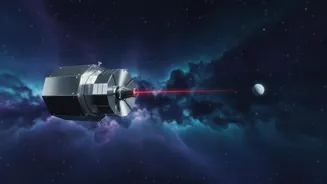
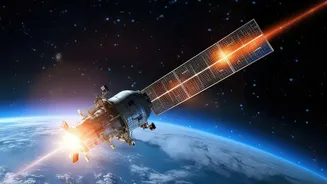
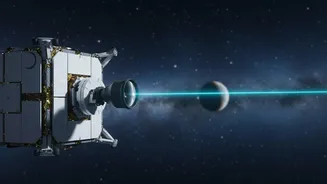
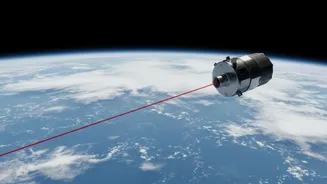
Laser, or optical, communication works differently. Instead of broad radio waves, it uses highly focused beams of near-infrared light to encode and transmit data. Because the light is packed into much tighter waves, it can carry significantly more information. The result is a massive boost in data rates, estimated to be 10 to 100 times greater than what state-of-the-art radio systems can achieve. This is the difference between a slow drip and a fire hose. The technology, known as Deep Space Optical Communications (DSOC), turns digital information into pulses of photons that can be beamed across millions of kilometres.
A Groundbreaking Test from Deep Space
NASA recently put this technology to the ultimate test with its DSOC experiment aboard the Psyche spacecraft. In a historic first, the system streamed an ultra-high-definition video from 19 million miles away. The 15-second clip of a cat named Taters was transmitted at a maximum rate of 267 megabits per second (Mbps)—faster than many home broadband connections. The signal took only 101 seconds to reach Earth. The experiment, which concluded in September 2025 after exceeding all its goals, successfully transmitted data from as far as 307 million miles away, proving the technology is ready for future deep space missions to Mars and beyond.
More Than Just Speed
The advantages of laser communication extend beyond just raw speed. The equipment is smaller, lighter, and requires less power than comparable RF systems. This is a huge benefit for spacecraft design, as it frees up mass and power for more scientific instruments. Furthermore, the narrowness of the laser beam makes it much more secure. While radio signals broadcast over a wide area and can be intercepted, a laser beam is extremely difficult to detect or tap into, enhancing security for sensitive data transmissions. Lasers also operate in a part of the electromagnetic spectrum that isn't crowded, avoiding the regulatory and congestion issues that plague radio frequencies.
The Future of Interplanetary Internet
This technology paves the way for a new era of space exploration. Future crewed missions, such as the Artemis flights to the Moon and eventual journeys to Mars, will be able to transmit high-definition video in near real-time, allowing for better mission support and public engagement. Scientists on Earth will receive vast amounts of data almost instantly, accelerating discovery. While the main application is space, the innovation could eventually influence terrestrial networks. The development of robust optical links between satellites could one day create a mesh network in space, potentially reducing our reliance on vulnerable undersea cables for global communication. As space agencies like NASA and ESA continue to perfect this capability, the dream of a high-speed interplanetary internet is quickly becoming a reality.