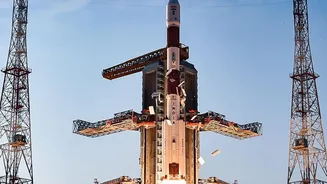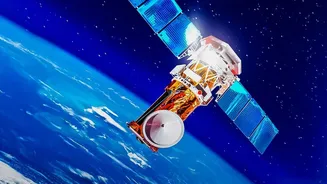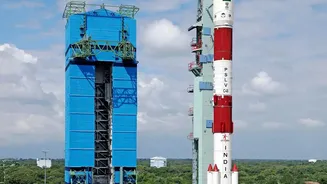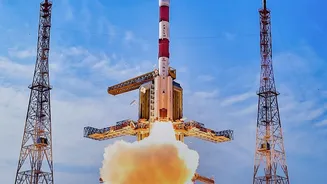







With Aditya-L1 now a cornerstone of solar observation after its successful positioning at Lagrange Point 1, its mission has evolved. Beyond national pride, its steady stream of data is becoming India's most powerful tool for scientific diplomacy.
From Launchpad to Global Laboratory
India's
first dedicated solar observatory, Aditya-L1, has transitioned from an engineering marvel into a fully operational scientific powerhouse. Since reaching its destination 1.5 million kilometres from Earth on January 6, 2024, the spacecraft has maintained an uninterrupted gaze upon the Sun. Its seven indigenously developed payloads are continuously capturing a wealth of information about the Sun's atmosphere, solar flares, and the solar wind. This strategic vantage point, free from Earth's shadow, allows ISRO to gather data that is not just a source of national achievement but a valuable asset for the entire global scientific community. As the Sun enters a period of peak activity, the data from Aditya-L1 is more critical than ever.
The Priceless Value of Solar Data
Aditya-L1 is observing our star in ways few other missions can. Its instruments, like the Visible Emission Line Coronagraph (VELC) and the Solar Ultraviolet Imaging Telescope (SUIT), provide unique insights into Coronal Mass Ejections (CMEs) — massive eruptions of plasma that can wreak havoc on Earth's infrastructure. These events can disrupt satellite communications, damage power grids, and pose a risk to astronauts. By studying these phenomena close to their origin, Aditya-L1 provides crucial information for improving space weather prediction models. The data helps scientists understand the fundamental physics of the Sun, such as the perplexing coronal heating problem — why the Sun's atmosphere is millions of degrees hotter than its surface. This unique capability makes Aditya-L1's observations a coveted resource for space agencies worldwide.
The New Currency of Space Diplomacy: Open Data
In a strategic shift that marks India's growing confidence as a space power, ISRO has committed to sharing Aditya-L1's data with the world. Through its Indian Space Science Data Centre (ISSDC) portal, the agency has made calibrated datasets available to researchers and academic institutions globally. This policy of open data is the primary mechanism through which collaborations are fostered. Instead of guarding its findings, ISRO is inviting international partners to dive into the data, propose new observations, and co-author studies. This approach accelerates the pace of discovery and embeds India deeply within the fabric of international solar physics research, transforming data into a powerful tool of scientific diplomacy.
Partnerships in Action: A Two-Way Street
The collaborative approach is already yielding significant results. ISRO has established formal partnerships with the European Space Agency (ESA) and NASA. In one landmark study, scientists from India and Europe combined observations from Aditya-L1's VELC instrument with data from ESA's Proba-3 mission to get an unprecedented view of CMEs near their birthplace. This joint analysis, published in a prestigious journal, demonstrates the power of coordinated observation. These collaborations are not one-sided. While India provides its unique data, it gains access to observations from other key missions like NASA's Parker Solar Probe and ESA's Solar Orbiter, allowing for a more complete and cross-verified understanding of solar events. ESA also provided crucial support during the mission's early phases, helping validate ISRO's flight dynamics software.
Beyond Science: Building India's Future in Space
Fostering these international ties does more than just advance science; it strengthens India's entire space ecosystem. These collaborations enhance India's credibility as a major spacefaring nation and attract global talent. The experience gained is vital for future ambitious projects, including the Gaganyaan human spaceflight programme and the planned Bharatiya Antariksha Station. By positioning itself as a collaborative and essential partner, ISRO is not just studying the Sun; it is building a framework for India's technological self-reliance and securing its place as a leader in the global space community for decades to come.