



The planets in our solar system appear to move with clockwork precision. But over billions of years, their future is surprisingly uncertain. A new type of study reveals why predicting their fate requires a cosmic game of chance, not a single forecast.
The Clockwork Solar System Myth
For centuries, thinkers from Isaac Newton onward have pondered the stability of the solar system. It seems like a perfectly balanced machine, with planets following predictable elliptical paths. On human timescales, this is true. We can send a probe to Mars with incredible accuracy because, over a few years, the gravitational pulls are well understood. But the 'n-body problem' in physics shows that as soon as you have three or more objects interacting through gravity—like the Sun, Jupiter, and Saturn—there is no single, clean mathematical equation that can predict their exact positions indefinitely. Each planet tugs on every other planet, creating a complex web of interactions that makes long-term certainty impossible.
Why A Single Prediction Is Impossible
The core issue is a phenomenon known as chaos theory. In a chaotic system, tiny, imperceptible differences in the starting conditions can lead to wildly different outcomes over long periods. This is often called the 'butterfly effect'. Imagine trying to predict the exact position of Jupiter in a billion years. Even an error in measuring its current position as small as a few millimetres would be magnified by countless gravitational nudges over the aeons, rendering any single prediction utterly meaningless. Because we can never know the exact state of the system to an infinite decimal point, a definitive forecast of the distant future is fundamentally out of reach. The solar system's behaviour is deterministic, but its chaotic nature makes it unpredictable.
From One Forecast to Hundreds of Possibilities
If you cannot make one perfect prediction, what is the alternative? This is where modern computing power and a probabilistic approach come in. Instead of one simulation, scientists now run hundreds or even thousands of them. In each simulation, they slightly tweak the initial conditions of the planets—their positions, velocities, and masses—within the tiny margins of measurement uncertainty. By observing the outcomes of this entire 'ensemble' of simulations, researchers can build a statistical picture of the future. It is similar to weather forecasting, where multiple models are run to determine the probability of rain rather than a single certain outcome. This method does not give a single answer, but it reveals the most likely futures and identifies the rare, but possible, scenarios of instability.
What the Latest Simulations Reveal
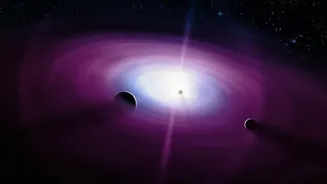
Recent studies using this simulation-heavy approach have focused on the role of the giant planets and the Sun's eventual death. For decades, it was thought the outer solar system would remain stable for up to 100 billion years. However, new research published in late 2026 suggests a much shorter, though still incredibly long, timescale. These studies modelled the Sun's death, not as a smooth process, but as a series of uneven mass-loss events. These 'kicks' from the dying Sun introduce more chaos. In hundreds of simulations, researchers found that the outer solar system could become unstable within just a billion years after the Sun becomes a white dwarf. In some of these simulated scenarios, Saturn was ejected from the solar system entirely, while Uranus and Neptune sometimes switched their orbital positions.
The Giant Planets as Cosmic Shepherds
While the giant planets are part of this chaotic dance, they are also the primary anchors of our solar system's stability. Jupiter's immense gravity, for instance, acts as a stabilizing force that helps to shepherd the inner planets and manage the orbits of countless asteroids. During simulations of instability, it is often Jupiter and Saturn's orbital relationship that dictates the fate of the others. Studies show that our current configuration is remarkably stable, and it would likely take an outside disturbance, like a passing star altering Neptune's orbit, or the dramatic changes of the Sun's late life, to significantly increase the odds of chaos in the next few billion years. For now, the giant planets are locked in a gravitational arrangement that keeps our corner of the galaxy relatively safe.