
A New Window on the Cosmic Dawn
Imagine peering back in time, not by decades or centuries, but by over 13 billion years. This is the everyday reality for astronomers using the James Webb Space Telescope (JWST), and their latest findings are truly revolutionary. Recent observations have
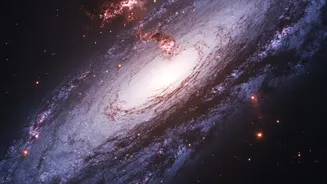
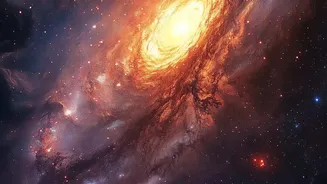
revealed galaxies in the very young universe that are far more developed and complex than any existing model had predicted. For years, theories suggested that the first galaxies would be small, chaotic, and still in the messy process of assembling themselves. Instead, Webb is showing us galaxies that already possess intricate structures and are surprisingly mature, some forming stars at incredibly high rates. One of the most startling discoveries involves a tightly packed collision of at least five galaxies, spotted when the universe was only about 800 million years old. This kind of complex merger was thought to happen much later in cosmic history. These findings suggest the early chapters of the universe's story unfolded very differently than we thought.
How Webb Pierced the Cosmic Veil
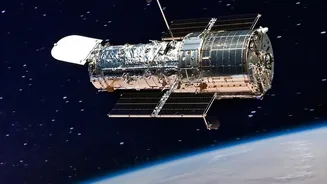
The James Webb Space Telescope is the key to this new understanding. As a powerful infrared observatory, it can capture the faint light that has travelled for billions of years from the most distant objects in the cosmos. Because the universe is expanding, the light from these early galaxies is stretched into longer, redder wavelengths—a phenomenon known as redshift. Webb's instruments are specifically designed to detect this infrared light, allowing it to see through the cosmic dust that would obscure the view of other telescopes like Hubble. This capability allows researchers to not only see these ancient structures but also to analyze their chemical makeup and internal movements. In one study, astronomers identified a galaxy just 4.5 billion years after the Big Bang that already had a dense, rotating disc of stars at its centre, a feature previously thought to be a mark of much older, more developed galaxies. This level of detail is rewriting the textbooks on when and how quickly galaxies settled into the ordered forms we see today.
Rewriting the Story of Galaxy Evolution
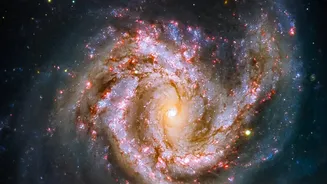
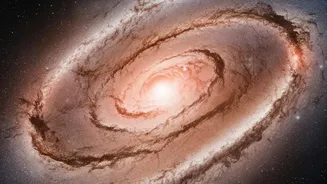
The standard model of cosmology holds that the universe began with the Big Bang about 13.8 billion years ago. For hundreds of millions of years, gravity slowly gathered huge clouds of gas that eventually ignited the first stars and galaxies. This process was expected to be gradual. However, the discovery of mature structures and massive galaxy mergers so early on challenges this timeline. It suggests that the processes of galaxy formation were either much faster or more efficient than previously understood. For example, some researchers have found evidence that bar-shaped structures of stars, which act like cosmic engines to build up the centres of galaxies, were already active in the early universe, reshaping their hosts far earlier than assumed. Another study uncovered a massive galaxy that showed no signs of rotation, a characteristic usually found in much older galaxies whose spin has been slowed by countless mergers over cosmic time. Finding such a galaxy so early suggests that some paths to maturity were surprisingly short.
Why This Matters for Us on Earth
These discoveries about remote galaxies may seem abstract, but they address fundamental questions about our own cosmic origins. Understanding how the first galaxies formed tells us about the conditions that eventually led to the creation of our Sun, our planet, and life itself. For instance, the violent collisions of early galaxies were responsible for spreading heavy elements, like the oxygen we breathe and the iron in our blood, out into the cosmos. Webb’s discovery that these processes were happening earlier and more vigorously than expected means the building blocks for planets and life were available sooner. Furthermore, these findings are a powerful reminder of how science works. Each new observation pushes the boundaries of our knowledge, forcing us to refine our theories and abandon old assumptions. The universe is not just a static picture to be observed; it's a dynamic story that is still being written, and with tools like the JWST, we are finally able to read its earliest pages.