



The Promise of Unhackable Communication
The most immediate and game-changing application of quantum technology for satellites lies in communication. Today's encryption relies on complex mathematical problems that, while difficult, could one day be broken by powerful quantum computers. Quantum
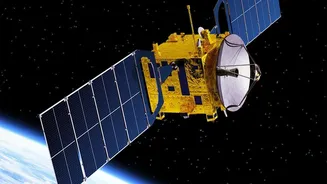
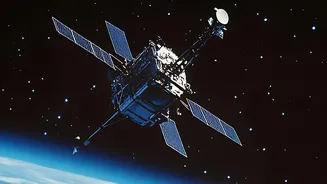
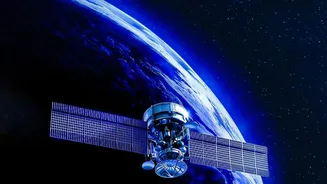
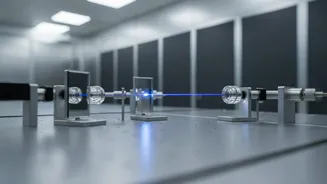
communication, however, is based on the laws of physics and is considered 'future-proof'. The core technology is called Quantum Key Distribution (QKD). In simple terms, QKD uses particles of light (photons) to generate and share a secret key for encrypting data. According to the principles of quantum mechanics, if anyone tries to intercept or observe these photons, their state changes instantly. This disturbance immediately alerts the sender and receiver that the key has been compromised, making eavesdropping impossible. By placing QKD systems on satellites, India could create an unhackable communication network for its military, financial institutions, and critical government databases, securing data across vast distances.
ISRO's Quantum Strides
The Indian Space Research Organisation (ISRO) is already making significant progress. Scientists have successfully demonstrated free-space QKD over a distance of 300 meters, transmitting encrypted data, images, and even conducting a secure video conference. These ground-based tests are crucial stepping stones toward the ultimate goal of Satellite-Based Quantum Communication (SBQC). These efforts are a key part of the National Quantum Mission, a major government initiative launched in 2023 with a budget of over ₹6,000 crore. A central goal of this mission is to develop satellite-based secure quantum communication between ground stations over a range of 2,000 kilometres within India, positioning the country among an elite group of nations with this capability.
Sharpening Our Vision from Space
Beyond secure communication, quantum technology promises to revolutionise how satellites see and sense the world. Quantum sensors, which leverage the extreme sensitivity of atomic systems, can lead to incredible advancements. One key area is navigation. While we rely on GPS (and India's own NavIC system), these are vulnerable to jamming and spoofing. Quantum sensors can be used to create next-generation atomic clocks and inertial navigation systems that do not depend on external satellite signals. This would provide our military and civilian transport with ultra-precise and tamper-proof positioning, navigation, and timing (PNT) capabilities, even in GPS-denied environments. These sensors could also dramatically improve Earth observation, allowing satellites to detect minute gravitational changes for resource mapping or even spot stealth aircraft through subtle environmental disturbances.
The Road Ahead for India
The integration of quantum and space technologies is not just a scientific curiosity; it is a strategic imperative. The National Quantum Mission has established four thematic hubs across the country, focusing on computing, communication, sensing, and materials, to create a robust ecosystem for research and development. ISRO's work focuses on developing the foundational hardware, from specialised photon sources to integrating quantum protocols with satellite and ground stations. The aim is to use these technologies for complex orbital calculations, mission planning, and developing the ultra-secure QKD networks of the future. By developing these capabilities indigenously, India is not just playing catch-up but is aiming to become a leader in designing and deploying the next generation of satellite technology.