






A Junkyard in Orbit
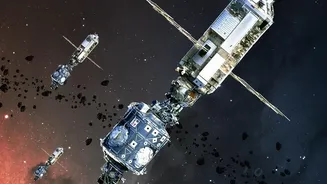
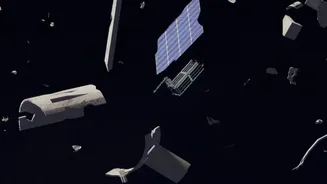
Space, particularly the Low Earth Orbit (LEO) where thousands of satellites operate, is not as empty as it seems. Decades of space activity have left behind a massive trail of junk. We're talking about defunct satellites, spent rocket stages, and millions
of smaller fragments from past collisions and break-ups. The European Space Agency estimates there are over a million pieces of debris larger than a centimetre orbiting Earth. While that may not sound big, these objects travel at terrifying speeds of up to 28,000 km/h. At that velocity, even a paint chip can strike an operational satellite with enough force to cause catastrophic damage. This growing cloud of space junk poses a direct and increasing threat to the vital satellites that power our communication, navigation, weather forecasting, and national security.
ISRO's Proactive Defence
Until recently, protecting satellites was a manual, ground-based effort. When tracking stations predicted a potential collision, engineers at the Indian Space Research Organisation (ISRO) would painstakingly calculate and command a Collision Avoidance Manoeuvre (CAM). These manoeuvres involve firing the satellite's onboard thrusters to slightly alter its course. But this process is slow and consumes precious fuel, which in turn shortens a satellite's operational lifespan. The number of these avoidance actions has been rising sharply. ISRO performed 20 such manoeuvres in 2025 and nine more in the first half of 2026 alone, highlighting the escalating risk. This reactive, human-in-the-loop system is becoming unsustainable in an increasingly congested orbital environment.
Enter the AI Shield
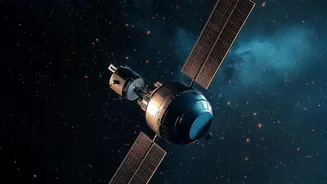
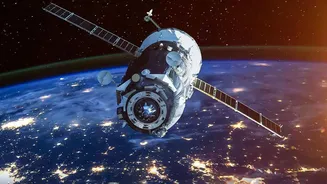
The next generation of Indian satellite protection is moving from the ground into space itself. The new approach involves autonomous collision avoidance systems powered by artificial intelligence. These smart systems are integrated directly into the satellites. Using advanced AI algorithms, they can continuously monitor their surroundings, predict potential threats with greater speed and accuracy, and make their own decisions. When a high-risk object is detected, the AI can independently calculate and execute the most efficient thruster burn to safely move out of the way, all without waiting for a command from Earth. This drastically reduces response time, saves fuel by optimizing manoeuvres, and frees up ground crews to focus on other critical mission tasks.
A Boost from Indian Startups
This technological leap is not happening in a vacuum. A vibrant ecosystem of Indian space-tech startups is playing a crucial role. Companies like Digantara are developing sophisticated Space Situational Awareness (SSA) platforms, creating detailed maps of orbital debris using their own hardware and AI software. Others, like Mumbai-based Manastu Space, are innovating in propulsion, developing safer and more efficient 'green' thruster systems perfect for these kinds of precise, autonomous manoeuvres. These collaborations, encouraged under government initiatives, are accelerating the development and deployment of cutting-edge technologies that bolster India's self-reliance and safety in space.
Securing India's Future in Space
For India, this technology is a strategic necessity. The nation has 22 active satellites in the debris-heavy Low Earth Orbit, forming the backbone of crucial services. Protecting these assets is paramount. Autonomous collision avoidance ensures the resilience and longevity of India's current and future space infrastructure, including the NavIC navigation constellation and Earth observation satellites. By developing and deploying these AI-powered systems, ISRO is not just protecting its own satellites; it's pioneering solutions for a global problem. This move positions India as a leader in space sustainability, demonstrating a commitment to being a responsible actor in the final frontier as part of its 'Debris Free Space Mission' initiative.