





Two National Bets, One Strategic Goal
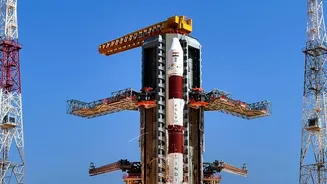
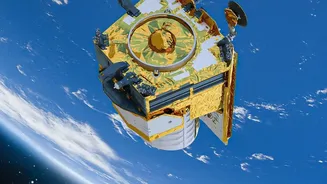
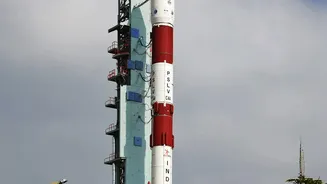
On one hand, you have the Indian Space Research Organisation (ISRO), which has earned a global reputation for cost-effective and reliable missions, from orbiting Mars to landing on the moon's south pole. Its satellites are the backbone of the nation's
communications, weather forecasting, and navigation. On the other hand, there's the National Quantum Mission (NQM), a major government initiative launched in 2023 with a multi-year budget of over ₹6,000 crore (about $720 million). The goal of the NQM is to make India a leader in quantum technology—a field that promises to revolutionize computing, communication, and sensing. While one mission looks to the stars and the other to the subatomic, their objectives are increasingly overlapping. This convergence is driven by a shared need for two things that will define the 21st century: truly secure data and highly intelligent systems. Recent comments from ISRO experts have confirmed that quantum technology and AI are seen as transformative for India's next generation of satellites.
The Unbreakable Code in Orbit
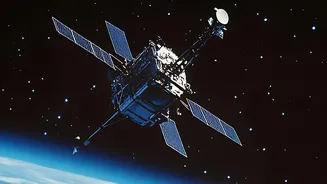
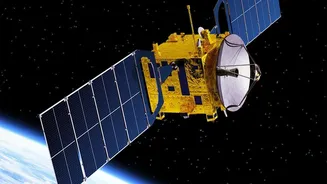
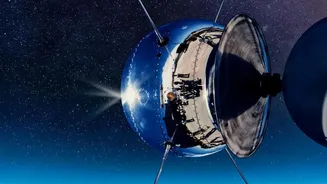
The most immediate point of convergence is secure communications. As more of our critical infrastructure—from banking and defense to energy grids—relies on satellite data, protecting those signals from interception becomes a paramount national security issue. Standard encryption methods are powerful, but experts worry they could one day be broken by the immense power of future quantum computers. The solution? Quantum communication itself. A key objective of India's National Quantum Mission is to develop satellite-based Quantum Key Distribution (QKD). Think of QKD as a way to create an unhackable code. It uses the principles of quantum mechanics to generate and share cryptographic keys. The physics behind it means that if a third party tries to eavesdrop on the key exchange, the very act of observing it disturbs the system and immediately alerts the sender and receiver. By integrating QKD technology into its satellites, India aims to create secure communication links over thousands of kilometers, both within the country and with international partners. ISRO has already signaled its intent to incorporate QKD for secure, encrypted communications.
Smarter Systems in the Sky
Beyond just securing data, the fusion of space and quantum promises to make orbital systems much smarter. One area is quantum sensing. India's NQM is focused on developing ultra-precise atomic clocks and magnetometers. In space, these technologies could lead to navigation systems that don't rely solely on GPS—which can be jammed or spoofed—and Earth observation satellites capable of detecting subtle gravitational or magnetic shifts, with applications in resource mapping and disaster management. The other major element is data processing. Satellites generate enormous volumes of data every day. The next step is to process that information in space itself using AI and machine learning, a concept known as edge computing. This allows for faster decision-making without having to send all the raw data back to Earth. Future quantum computers, another goal of the NQM, could eventually take this to a new level, analyzing vast and complex datasets from constellations of satellites to model climate change, optimize agricultural output, or manage urban development with unprecedented speed and accuracy.
Building a Self-Reliant Tech Future
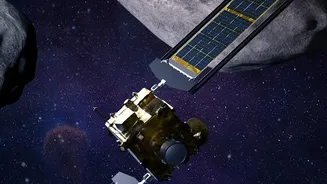
Ultimately, this convergence is about more than just technological capability; it's a strategic move toward what India calls 'Atmanirbhar Bharat,' or a self-reliant India. By developing these critical technologies domestically, India aims to reduce its dependence on foreign hardware and software, from satellite components to encryption protocols. This push for self-reliance is fostering a growing ecosystem of private startups in the space and tech sectors, supported by government initiatives. Experts at recent national technology conferences have emphasized that this indigenous innovation in areas like AI, quantum, and advanced radar systems is key to India's ambition to become a leading global space power. The successful docking of satellites in 2025 was a clear signal that India is mastering the building blocks for more complex in-orbit operations. Marrying its proven space program with its forward-looking quantum mission is the next logical step in solidifying that position.