






In the grand quest to understand the universe, scientists have a solid rulebook, but it’s missing some major chapters. Now, evidence of a particle’s incredibly rare transformation may provide a new way to hunt for clues to cosmic mysteries.
A Fleeting Glimpse of a Rare Event
After a search
spanning more than 40 years, physicists at CERN's Large Hadron Collider (LHC) have found the first evidence from a single experiment of an exceptionally rare particle decay. The event involves a particle containing a 'beauty' quark, an exotic and heavier cousin of the up and down quarks that form protons and neutrons in the atoms all around us. These beauty particles are created in huge numbers during the LHC's high-energy collisions, but they are incredibly short-lived, surviving for only about one and a half trillionths of a second before decaying into other, lighter particles. The specific process observed, known as 'Bd to mu mu', involves a beauty particle decaying into two muons, which are heavier relatives of the electron. This is an event so rare it is predicted to happen only once in every ten billion beauty particle decays, making its detection a monumental achievement.
Testing the Universe's Rulebook
This discovery is significant because it provides a new, ultra-precise way to test the Standard Model of particle physics. The Standard Model is the 'rulebook' that describes all known fundamental particles and the forces that govern them. It has been incredibly successful, but it has major gaps: it cannot explain gravity, the nature of invisible dark matter that fills the universe, or why there is so much more matter than antimatter. Because this newly observed decay is so rare, its properties are extremely sensitive to the influence of any unknown particles or forces. If the decay happens at a rate different from what the Standard Model predicts, it could be a sign of 'new physics' hiding in what some call the 'zeptoverse'—an unimaginably small realm where new discoveries may lie.
The Dark Matter Connection
So, how does a beauty particle relate to dark matter? The link is indirect but powerful. The beauty particle itself is not dark matter. Instead, by measuring this rare decay with extreme precision, physicists are putting the Standard Model under the most stringent test possible. Many theories that extend beyond the Standard Model to explain dark matter also predict the existence of new, undiscovered particles. These hypothetical particles could subtly influence the rate at which the beauty particle decays. For decades, this type of rare decay has been seen as a 'golden channel' for finding hints of new physics. If observations deviate from predictions, it could point scientists toward which new theories—and which potential dark matter candidates—are the most promising to investigate.
What Do the Results Say?
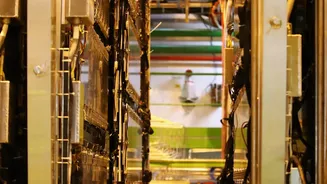
The result, which combines new data from 2024 and 2025 with earlier data, reached a statistical significance of 3.2 sigma. In particle physics, this is enough to be classified as 'evidence' but falls short of the 'five-sigma' gold standard required to claim a formal 'discovery'. For now, the measurement agrees with the predictions of the Standard Model. While this doesn't reveal any new physics just yet, it's still a crucial result. It helps scientists narrow down the possibilities for what might lie beyond our current understanding by ruling out certain theories. The precision of the measurement itself is a triumph, made possible by a major upgrade to the LHCb experiment, which can now record data five times faster than before and use machine learning to sift through the noise.
The Search Continues
This is not the end of the story but rather a thrilling new chapter. The LHCb experiment will continue to collect more data, aiming to increase the statistical certainty of the measurement and hopefully push it past the five-sigma threshold for discovery. Along with this 'Bd to mu mu' decay, researchers also made the most precise measurements ever of a related, slightly more common decay called 'Bs to mu mu'. By studying these rare processes in tandem, physicists can get a more complete picture and further constrain the possibilities for new particles and forces. Each new measurement, even one that confirms the Standard Model, sharpens our view of the fundamental laws of nature and guides the path forward in our search for answers to the universe's deepest questions.