







A Day Longer Than a Year
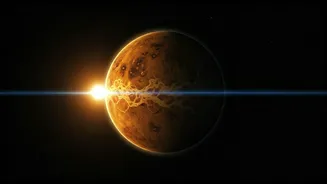
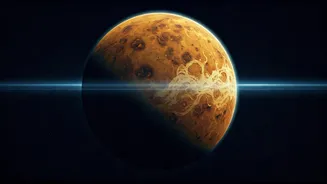
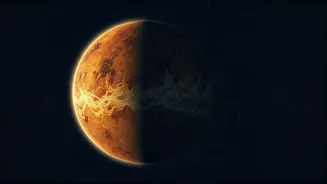
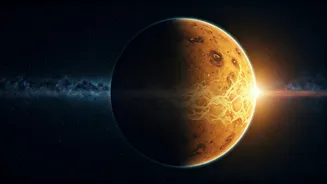
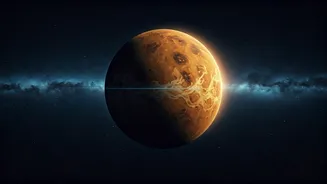
Imagine a day that drags on for longer than an entire year. On Venus, that’s reality. A single day on Venus—the time it takes for the planet to complete one full rotation on its axis—is approximately 243 Earth days. But it only takes Venus about 225 Earth days to complete one full orbit
around the Sun (a Venusian year). This means that if you were standing on the surface of Venus, you would experience a full year passing before a single day-night cycle is complete. It’s a mind-bending concept that makes our 24-hour cycle seem lightning-fast. This isn't just an estimate; precise radar measurements taken over years have nailed down these numbers, confirming the profound strangeness of our neighbour’s timekeeping.
Spinning the Wrong Way
As if a day lasting longer than a year wasn’t odd enough, Venus also spins backwards. Nearly every planet in our solar system, including Earth, rotates on its axis in a counter-clockwise direction when viewed from above the Sun's north pole. This is known as prograde motion. Venus is the rebel; it has a retrograde, or clockwise, rotation. The Sun on Venus, if you could see it through the thick clouds, would rise in the west and set in the east. The combination of this slow, backward spin means the time from one sunrise to the next (a solar day) on Venus is about 117 Earth days. Scientists have two main theories for this bizarre behaviour. One posits that a massive collision with a planet-sized object early in its history knocked Venus off-kilter and reversed its spin. The other suggests that over billions of years, the gravitational pull of the Sun on Venus’s incredibly dense atmosphere created a powerful tidal effect, slowing and eventually reversing its rotation.
The Heavy, Dragging Atmosphere
The leading culprit behind Venus’s sluggish spin is its crushingly thick atmosphere. The Venusian atmosphere is more than 90 times denser than Earth's, with surface pressure equivalent to being nearly a kilometre deep in our ocean. This colossal blanket of gas, mostly carbon dioxide, exerts immense friction on the planet's surface. Think of it like a powerful brake constantly being applied to the solid planet beneath. Furthermore, the upper layers of Venus's atmosphere are super-rotating, whipping around the planet in just four Earth days. This massive, fast-moving atmospheric tide exchanges a huge amount of momentum with the solid planet, contributing to the slow rotation and even causing slight variations in the length of a Venusian day, which modern radar can now detect.
How We Measure a Planet's Crawl
Confirming these details requires incredible precision. Scientists don't use a simple stopwatch; they use powerful radio telescopes on Earth to perform a technique called radar speckle tracking. For over a decade, researchers used NASA's Goldstone Solar System Radar in the Mojave Desert to bounce radio signals off the surface of Venus. As the planet rotates, features on its surface move, causing tiny changes in the returning radar echo. By analysing these 'speckles' in the signal over many years, scientists can measure the planet's spin speed, the slight wobble of its axis (precession), and the orientation of its core with unprecedented accuracy. These recent studies have provided the most precise measurement of Venus's day to date, confirming that it varies by as much as 20 minutes due to its atmospheric drag.
Why This Cosmic Oddity Matters
Understanding Venus's rotation is more than just collecting planetary trivia. These precise measurements are crucial for understanding the planet as a whole. For instance, the exact amount of wobble in its spin gives scientists clues about the size and state of its core—whether it is liquid or solid. Knowing the exact orientation of the planet is also vital for future missions. Spacecraft aiming to land on Venus or enter its orbit need to know precisely where their target will be. Most importantly, studying Venus helps us understand why a planet so similar to Earth in size and composition ended up as a runaway greenhouse hellscape. Its slow rotation and atmospheric dynamics are key pieces of that puzzle, offering a cautionary tale for planetary evolution.