

Seeing the Unseen
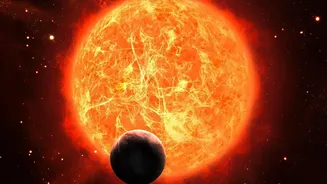
Observing an exoplanet—a planet outside our solar system—is incredibly difficult. They are unimaginably far away and completely lost in the blinding glare of their host stars. Directly photographing one is like trying to spot a firefly next to a searchlight
from kilometres away. So, astronomers get creative. Instead of looking for the planet itself, they watch the star, waiting for the tiny, tell-tale dip in its brightness that occurs when a planet passes in front of it. This event is called a transit. While this confirms a planet's existence and size, the real magic happens when scientists analyze the starlight that filters through the planet's atmosphere during this transit. That faint light carries the secrets of alien worlds.
The Power of Infrared
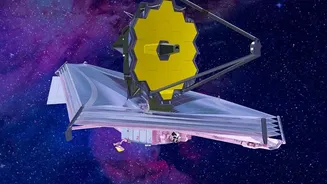
Every object with a temperature, from a star to a planet to a person, emits energy in the form of infrared light. It's essentially heat radiation. While clouds on a distant planet might block visible light, they can be transparent to certain wavelengths of infrared light. This makes infrared astronomy the perfect tool for peering into exoplanet atmospheres. Telescopes like the James Webb Space Telescope (JWST) are designed to be exquisitely sensitive to these infrared signals. By capturing this light, astronomers can move beyond simply detecting a planet to actually characterizing its environment. It's the difference between knowing a place exists and getting a detailed weather forecast for it.
Decoding Atmospheric Barcodes
The core technique for this analysis is called spectroscopy. When starlight passes through an exoplanet's atmosphere, different chemical elements and molecules absorb very specific wavelengths of that light. Each molecule, whether it's water vapour, methane, or even vaporized silicates (rock), leaves a unique pattern of missing light—a kind of chemical barcode or fingerprint—in the spectrum. By subtracting the star's normal light spectrum from the spectrum taken during a transit, astronomers can isolate these atmospheric fingerprints. This tells them exactly what the planet's atmosphere, and its clouds, are made of. On some 'hot Jupiter' exoplanets, this method has revealed clouds not of water, but of minerals like silicate, essentially meaning it rains glass or sand.
From Composition to Climate Maps
Identifying atmospheric contents is just the first step. To understand weather, scientists track the planet's brightness throughout its entire orbit, not just during a transit. This observation, called a 'phase curve', measures the combined light of the star and the thermal glow of the planet itself. As the planet orbits, we see its different faces, from the hot, permanently sun-baked dayside to the cooler nightside. The difference in temperature between these two sides, measured in infrared, drives ferocious winds. On the exoplanet WASP-43 b, for example, observations suggest clear skies on the dayside, thick clouds on the nightside, and equatorial winds whipping around the planet at over 8,000 kilometres per hour (5,000 mph).
A New Era of Cosmic Meteorology
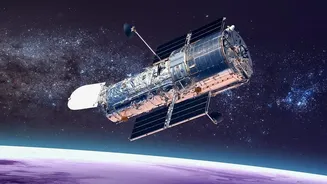
Before the James Webb Space Telescope, observatories like Hubble and Spitzer paved the way, giving us our first glimpses of these extreme climates. But JWST's unprecedented sensitivity in the mid-infrared spectrum has been a game-changer, allowing for much more precise measurements. It can measure temperature variations with remarkable accuracy and has detected the chemical signature of quartz clouds on one world and measured the temperature of a rocky planet for the first time. This has enabled scientists to create rough but astonishing temperature maps of these distant worlds, transforming our understanding of their climates. What used to be a single point of light is now a world with discernible weather patterns, like cloudy mornings and clear evenings.