





The Sun's Unseen Temper
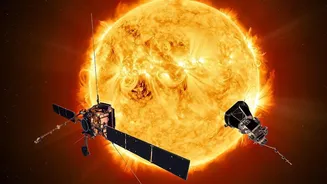
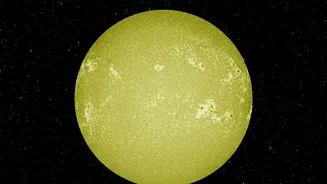
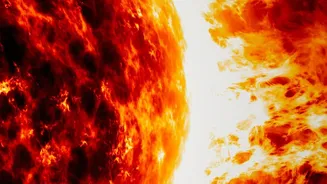
A solar storm is a powerful burst of energy from the Sun's atmosphere. These events come in several forms, but the most impactful are solar flares and Coronal Mass Ejections (CMEs). A solar flare is an intense flash of radiation, while a CME is a gigantic
cloud of solar plasma and magnetic fields that erupts from the sun. When a CME is aimed at Earth, it can travel across the 150 million kilometres from the sun in just 15 hours to a few days. These are not just beautiful light shows; they are significant disturbances to the space environment around our planet.
A Threat to Modern Life
The danger from a solar storm comes from its interaction with Earth's magnetic field. This collision can induce powerful electrical currents, known as Geomagnetically Induced Currents (GICs), in long conductors on the ground. Power transmission lines act as giant antennas for these currents, which can flow into electrical grids and overload high-voltage transformers, potentially causing widespread blackouts. In space, the risks are just as severe. The flood of charged particles can damage sensitive satellite electronics, disrupting GPS navigation, weather forecasting, and global communications. It can also heat the upper atmosphere, increasing drag on low-orbit satellites and causing their orbits to decay.
Our Eyes on the Sun
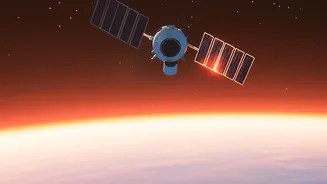
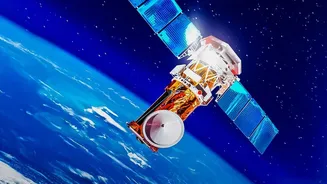
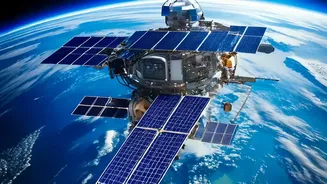
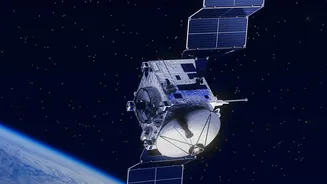
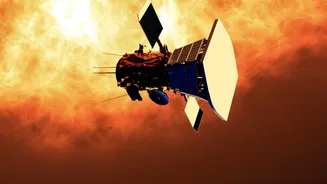
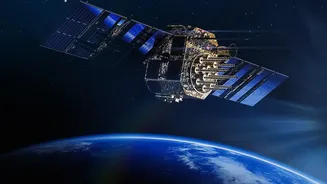
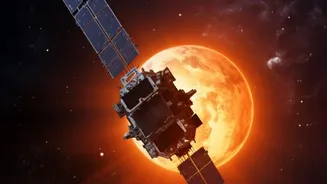
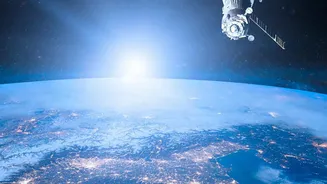
Fortunately, we aren't flying blind. A sophisticated global network of space- and ground-based observatories keeps a constant watch on the Sun. The primary agency for this in the United States is NOAA's Space Weather Prediction Center (SWPC), which works with international partners. These networks use satellites like the Deep Space Climate Observatory (DSCOVR) and the Geostationary Operational Environmental Satellites (GOES) to get a direct view of solar activity. Crucially, India has become a key player in this global effort with its Aditya-L1 solar observatory. Positioned at the L1 Lagrange point, Aditya-L1 provides continuous, unobstructed views of the Sun, helping to track CMEs and improve space weather models.
From Data to Warning
Monitoring is a multi-step process. First, satellites observe the Sun for tell-tale signs of an eruption, like a solar flare or the beginning of a CME. Once a potentially Earth-directed CME is spotted, scientists use computer models to predict its speed, trajectory, and arrival time. This can provide anywhere from 18 hours to several days of advance notice. As the CME travels, observatories like DSCOVR, which sit between the Sun and Earth, directly sample the solar wind. This provides a much more precise, short-term warning—typically 15 to 60 minutes—before the storm impacts our planet's magnetic field. The SWPC then issues a series of bulletins: a 'Watch' for potential storms, a 'Warning' for an imminent impact, and an 'Alert' when the storm is in progress.
Taking Protective Action
These warnings are not just for scientists; they are actionable intelligence for critical industries. When a strong geomagnetic storm is forecast, electric grid operators can take preemptive measures to protect their systems. This might include reducing stress on the grid, postponing maintenance, or strategically taking some equipment offline to prevent catastrophic damage to transformers. Satellite operators can put their spacecraft into a protective 'safe mode,' powering down non-essential electronics to shield them from harmful radiation. Airlines may reroute flights, particularly those over the polar regions, to avoid communication blackouts and elevated radiation exposure for passengers and crew. These coordinated efforts are crucial for mitigating the worst effects of a solar storm.