




More Than Meets the Eye
The light our eyes can see is just a tiny slice of the vast electromagnetic spectrum, which includes everything from low-energy radio waves to high-energy gamma rays. Objects in the universe emit radiation across this entire spectrum. Different wavelengths
tell different stories because they are produced by different physical processes and temperatures. Cool dust and gas glow in infrared and radio, while hot, young stars shine brightly in visible and ultraviolet light. The most energetic events, like exploding stars or matter falling into a black hole, unleash X-rays and gamma rays. Telescopes are designed to detect these specific types of light, acting as specialised windows onto the cosmos. By combining views from different observatories, astronomers can piece together a more complete understanding of a celestial object.
A Tale of Two Telescopes: Hubble and Webb
Two of the most famous space observatories, the Hubble Space Telescope and the James Webb Space Telescope (JWST), provide a perfect example of this multi-wavelength approach. Hubble primarily observes in visible and ultraviolet light, capturing the stunning starscapes that have graced our screens for decades. JWST, on the other hand, is a master of the infrared spectrum. Because infrared light has longer wavelengths, it can pass through the dense clouds of cosmic gas and dust that obscure visible light. This allows JWST to peer into stellar nurseries and reveal the skeletal structures of galaxies that are hidden from Hubble's view. When their observations are combined, it's like switching from seeing a person's skin to suddenly viewing their entire skeletal and circulatory systems.
Revisiting the Whirlpool Galaxy
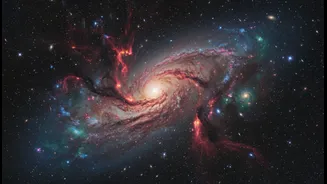
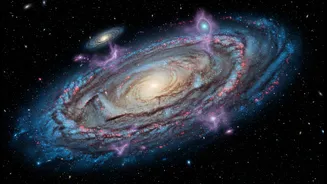
A perfect case study is the magnificent Whirlpool Galaxy, also known as M51. Located about 31 million light-years away, it is a grand-design spiral galaxy famous for its well-defined, graceful arms. In images from Hubble, M51 is a classic beauty, with brilliant blue clusters of young stars and pinkish regions of star formation tracing its spiral arms. But dark lanes of dust cut through the scene, hiding what lies within. This is the galaxy as we’ve known it for years—a familiar and beloved cosmic landmark. It is currently interacting with a smaller companion galaxy, NGC 5195, whose gravitational pull is thought to be responsible for triggering waves of star formation and defining those prominent arms.
The Infrared Revelation
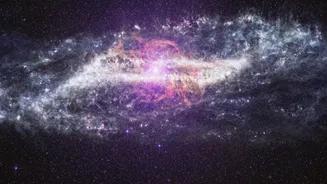
When JWST turned its infrared gaze upon M51, the galaxy transformed. The dark dust lanes that appeared as shadowy voids to Hubble were suddenly glowing. JWST’s infrared instruments revealed a complex, filamentary web of warm dust and gas. These images show the raw materials for future star formation in incredible detail. The orange and yellow hues highlight regions of ionised gas, energised by newly formed star clusters, while deep red areas trace the distribution of cosmic dust. For the first time, scientists could see star clusters emerging from their cocoons, a process previously hidden from view. It’s a completely different personality for the galaxy, showing not just the finished product (stars) but the entire factory floor.
Completing the Picture with X-Rays
To get an even fuller picture, we can add another layer: X-rays, as seen by NASA’s Chandra X-ray Observatory. When Chandra observes the Whirlpool Galaxy, a new set of objects populates the view. The spiral arms are dotted with brilliant points of purple light. These aren't typical stars, but the sites of extreme cosmic violence: binary systems where a neutron star or black hole is stripping material from a companion star, and the superheated gas left behind by supernova explosions. These X-ray sources reveal the end-of-life stages for massive stars, providing a powerful contrast to the infrared views of stellar birth. Together, the visible, infrared, and X-ray images tell a sweeping story of galactic life, from birth to death.