



The Target: What is a Super-Earth?
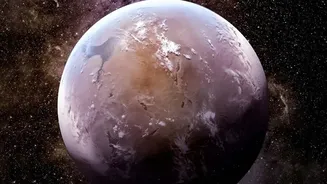
Before we dive into the 'how,' let's clarify the 'what.' A super-Earth is a class of exoplanet—a planet outside our solar system—with a mass higher than Earth's but substantially below that of our solar system's ice giants, Uranus and Neptune. They can
be up to 10 times more massive and 2.6 times larger in radius than our home world. These planets are incredibly common in our galaxy, but we have none in our own solar system, making them a fascinating mystery. Some, like K2-18 b, orbit their star within the 'habitable zone,' a region where temperatures could theoretically allow liquid water to exist on the surface.
The Method: Starlight and Shadows
Detecting anything in the atmosphere of a planet light-years away sounds impossible, but the method is ingeniously simple in concept. It's called transmission spectroscopy. Scientists wait for the exoplanet to 'transit,' or pass in front of its host star from our point of view. As the planet makes this journey, a tiny fraction of the star's light filters through the planet's atmosphere before it reaches Webb's mirrors. That filtered light carries the chemical secrets of the planet's sky. Think of it like a silhouette, but instead of just blocking the light, the atmosphere changes it in subtle, measurable ways.
The Key: Why Infrared Light Matters
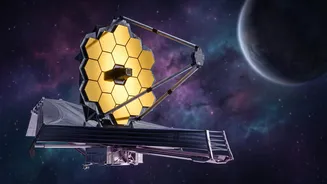
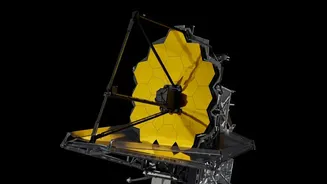
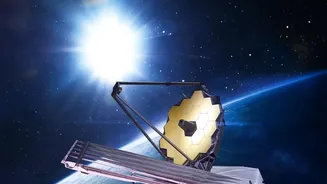
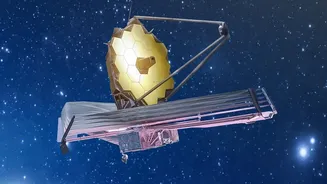
This is where the James Webb Space Telescope's specific design becomes crucial. Earth's atmosphere blocks most infrared light, which is why a space-based observatory is essential. Molecules in an exoplanet's atmosphere, such as water vapour, methane, and carbon dioxide, absorb very specific wavelengths of infrared light. Each molecule leaves a unique 'fingerprint' on the starlight passing through it. JWST's highly sensitive infrared instruments, like the Near-Infrared Spectrograph (NIRSpec) and the Mid-Infrared Instrument (MIRI), are specifically designed to capture this light and spread it out into a spectrum, like a rainbow.
The Analysis: Reading the Chemical Fingerprints
After capturing the light, scientists perform a clever subtraction. They compare the spectrum of the starlight when the planet is in front of it to the spectrum of the star by itself. The difference between the two reveals which wavelengths of light were absorbed by the planet's atmosphere. Where the light is missing, there's a dip in the spectrum. This dip is the chemical signature. A specific pattern of dips indicates the presence of water vapour. For example, observations of the super-Earth K2-18 b revealed not just water, but also methane and carbon dioxide, painting a picture of a potential 'Hycean' world—a planet with a hydrogen-rich atmosphere and a water ocean.
Mapping Vapour: From Detection to Understanding
The term 'mapping' doesn't mean creating a geographical map with continents and oceans. Instead, it refers to charting the chemical composition of the atmosphere. By analysing the strength and shape of the water vapour signature, scientists can infer its abundance and even get clues about the planet's temperature and cloud cover. For some planets, like GJ 486 b, the signal is complex; the water vapour detected could be from the planet's atmosphere or from cool spots on the star itself. Further observations are needed to distinguish between these possibilities, but the ability to even pose such a detailed question is a massive leap forward in exoplanet science.