



More Than Just Pretty Lights
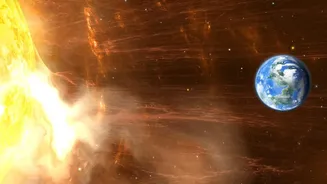
When most people think of solar activity, they might imagine the beautiful aurora borealis. But the same solar phenomena that create those dancing lights can wreak havoc on our technology. Space weather refers to the conditions in space, primarily driven
by the Sun, that can affect Earth and its technological systems. The main culprits are solar flares, which are massive bursts of radiation, and coronal mass ejections (CMEs), which are giant clouds of plasma and magnetic fields hurled from the Sun. When Earth is in the path of these events, it can trigger geomagnetic storms that have serious consequences.
How a Solar Storm Can Cripple a Satellite
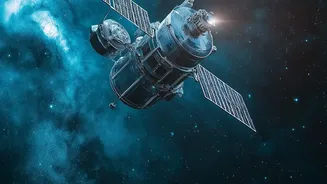
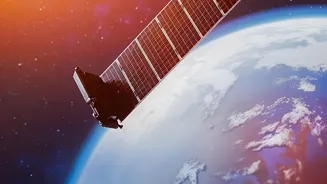
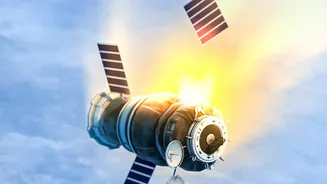
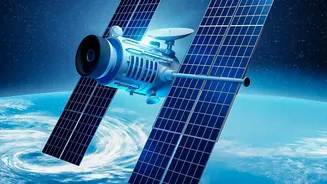
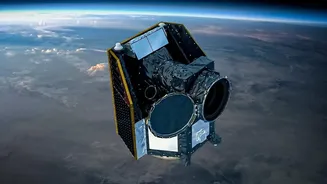
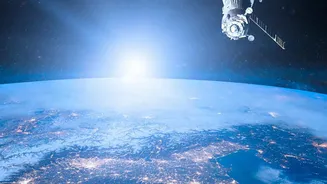
Satellites operate outside the full protection of Earth's atmosphere and magnetic field, making them highly vulnerable to space weather. The high-energy particles from a solar flare can damage sensitive electronics, corrupt software with phantom commands, and degrade solar panels, shortening a satellite's operational lifespan. Furthermore, a powerful geomagnetic storm can heat and expand Earth's upper atmosphere. This increased density creates more drag on satellites in low-Earth orbit (LEO), causing them to lose altitude faster than expected. If they can't correct their orbit in time, they risk premature re-entry and burning up.
The Domino Effect on the Ground
A malfunctioning or lost satellite isn't just an isolated problem in space; its effects ripple across our deeply interconnected world. The Global Navigation Satellite System (GNSS), which includes GPS, is essential for everything from aviation and shipping to precision agriculture and financial services that rely on its timing signals. A space weather event could disrupt these signals, leading to significant inaccuracies or complete loss of service. Communication networks, which handle everything from credit card transactions to emergency broadcasts, are also at risk. A severe event could trigger widespread power blackouts by inducing currents in national grids, causing a cascade of failures across all dependent infrastructure.
India's Eyes on the Sun
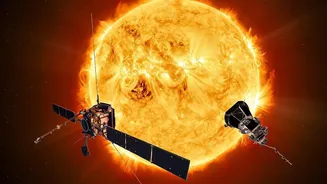
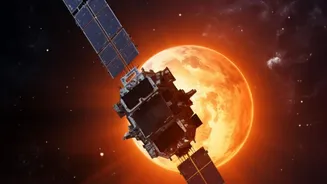
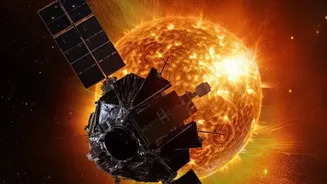
For a nation rapidly advancing its digital infrastructure, the stakes are incredibly high. India's reliance on satellite technology for disaster management, financial services, and connecting remote areas makes it particularly vulnerable. Recognizing this, the Indian Space Research Organisation (ISRO) has taken a proactive step with the Aditya-L1 mission. Positioned 1.5 million kilometers from Earth, Aditya-L1 has an uninterrupted view of the Sun. Its suite of instruments is designed to study solar flares and CMEs, providing crucial data that serves as an early warning system. While primarily a solar physics mission, the data from Aditya-L1 is a significant step toward building a robust space weather prediction capability for India.
The Global Race to Forecast the Skies
India is not alone in this effort. Agencies around the world, like the USA's National Oceanic and Atmospheric Administration (NOAA), operate a network of ground-based and space-based observatories. These organisations work together, sharing data to create a global picture of solar activity. Much like terrestrial weather forecasting, space weather prediction involves complex models and continuous monitoring to issue timely watches and warnings. These forecasts give satellite operators, airlines, and power grid managers crucial time to take protective measures, such as putting satellites into a safe mode or rerouting flights to avoid radiation exposure.