




The Grand Offering: Chappan Bhog
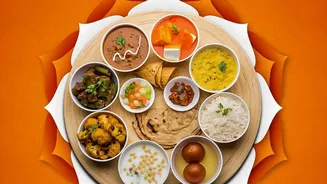
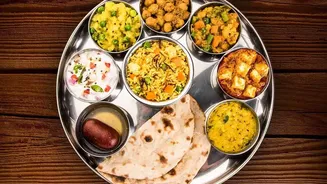
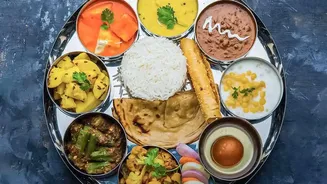
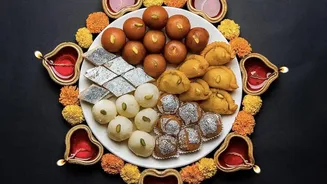
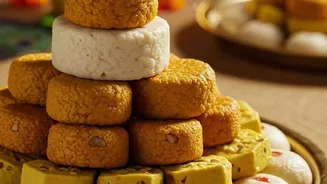
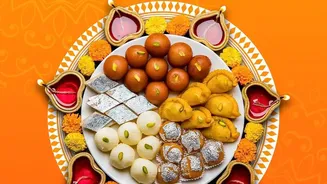
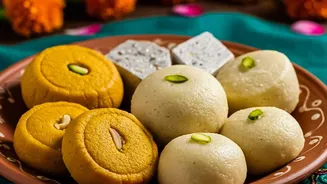
The most extravagant culinary tradition associated with Janmashtami is the 'Chappan Bhog', a devotional offering of 56 distinct food items to Lord Krishna. This elaborate feast is rooted in a legend where Krishna lifted the Govardhan Hill for seven days
to protect villagers, missing his eight daily meals. In gratitude, the villagers prepared a feast of 56 dishes (seven days multiplied by eight meals). The spread is a spectacular display of culinary artistry, including a variety of sweets, savouries, grains, fruits, and dairy products. While preparing all 56 dishes is a grand undertaking, the spirit of the tradition lies in the act of devotional cooking and offering a variety of Krishna's favourite foods, especially those made with milk, butter, and yogurt.
North India: Dhaniya Panjiri and Makhan Mishri
In North India, particularly in regions like Uttar Pradesh and Punjab, Janmashtami fasting is often broken with Dhaniya Panjiri. This unique prasad is made by roasting coriander seed powder in ghee with powdered sugar, nuts, and makhana (fox nuts). It's a warming, aromatic preparation specifically made for the occasion. Another quintessential offering is Makhan Mishri, a simple yet profound blend of fresh white butter and rock sugar crystals. This dish directly evokes the image of a young, mischievous Krishna, fondly known as 'Makhan Chor' or the butter thief.
Maharashtra: Gopalkala
In Maharashtra, Janmashtami celebrations are synonymous with the energetic 'Dahi Handi' ritual, and the prasad that follows is often Gopalkala. This savoury dish is a simple, no-cook mix that symbolises the food Krishna shared with his friends, the cowherds ('gopalas'). It's made with beaten rice (poha), yogurt, chopped cucumber, fresh coconut, and a tempering of ghee, cumin seeds, and green chillies. Pomegranate seeds and soaked chana dal are sometimes added for texture and flavour. Its charm lies in its simplicity and communal nature, meant to be mixed together and shared joyfully.
South India: Seedai and Murukku
For Krishna Jayanthi, as the festival is known in Tamil Nadu and other parts of South India, the kitchen buzzes with the preparation of various crunchy, fried snacks. The undisputed star is Seedai, a small, deep-fried rice flour ball. It comes in two main varieties: Uppu (salt) Seedai, which is savoury, and Vella (jaggery) Seedai, which is sweet. Making them is considered an art, as the dough must be perfect to prevent the snacks from bursting in the hot oil. Alongside Seedai, various types of Murukku, a crispy, spiral-shaped snack, are also prepared. Given Krishna's love for butter, Butter Murukku is an especially popular choice.
East India: Taler Bora
In Bengal and surrounding regions, Janmashtami coincides with the season of the sugar palm fruit (Taal). This leads to the preparation of a beloved seasonal delicacy called Taler Bora. These are sweet, deep-fried fritters made from the ripe pulp of the sugar palm, mixed with rice flour, semolina, coconut, and sugar or jaggery. The result is a wonderfully fragrant snack that is crispy on the outside and soft on the inside. The distinct flavour of the palm fruit makes this a unique festive treat, connecting the celebration to the region's seasonal bounty.