

Why More Than Squats?
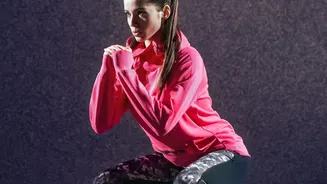
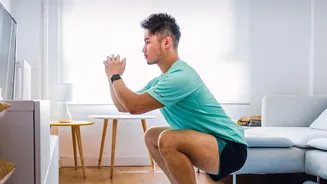
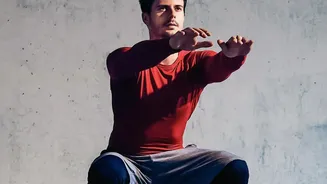
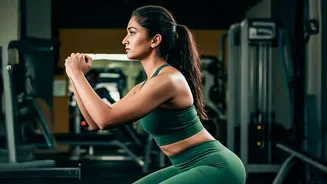
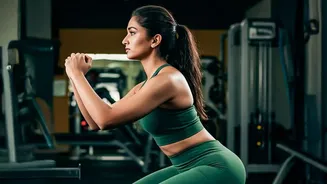
Bodyweight squats are a fantastic starting point, primarily targeting your quadriceps and glutes. However, your legs are a complex system of muscles. Over-relying on one exercise can lead to muscular imbalances, where some muscles become much stronger
than others. This not only limits your overall strength potential but can also increase the risk of injury. By alternating squats with other movements, you ensure that you are also strengthening your hamstrings (the back of your thighs), adductors (inner thighs), and abductors (outer thighs), creating a stable and more resilient lower body.
The Unilateral Challenge: Lunges
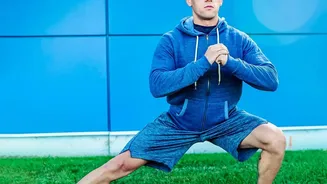
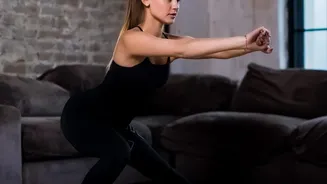
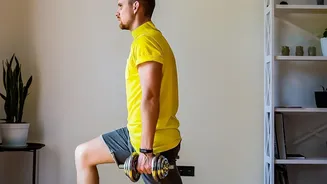
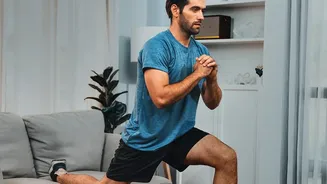
Lunges are an excellent complement to squats because they are a unilateral exercise, meaning they train one leg at a time. This challenges your balance and core stability in a way that squats do not. Working each leg independently helps to identify and correct strength imbalances between your left and right sides. You can perform forward lunges, reverse lunges, or lateral (side) lunges to target your muscles from different angles. Reverse lunges are often recommended for beginners as they can be easier on the knees.
Targeting the Posterior: Glute Bridges
While squats work your glutes, the glute bridge isolates them along with your hamstrings, which make up the posterior chain. This exercise is performed lying on your back, which removes pressure from the knees and lower back, making it a very safe and effective movement. To perform a glute bridge, lie on your back with your knees bent and feet flat on the floor, hip-width apart. Drive through your heels to lift your hips toward the ceiling, squeezing your glutes at the top before slowly lowering back down.
Inner and Outer Thighs
The inner thighs (adductors) and outer thighs (abductors) are crucial for hip stability but are often overlooked in basic workout routines. Incorporating exercises that specifically target these areas is essential for preventing knee injuries. Lateral lunges are a great two-in-one move, working the quads and glutes while also engaging the inner and outer thigh. For a more isolated movement, try side-lying leg raises. Lie on your side and slowly lift your top leg towards the ceiling, keeping your core engaged to prevent your torso from rocking.
Creating Your At-Home Leg Day
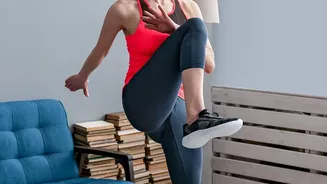
The key to an effective routine is balance. You don't need to do every exercise in one session. Instead, structure your workouts to give different muscle groups attention. A simple weekly plan could look like this: Workout A: Focus on compound, forward-and-back movements. Start with 3 sets of bodyweight squats, followed by 3 sets of reverse lunges on each leg. Finish with calf raises. Workout B: Focus on the posterior chain and hip stability. Begin with 3 sets of glute bridges, followed by 3 sets of side-lying leg raises for your outer thighs and then your inner thighs. Finish with 3 sets of lateral lunges.Perform each workout once or twice per week, ensuring at least one day of rest in between to allow your muscles to recover and grow stronger. Focus on maintaining proper form over the number of repetitions you perform.