



A New Window on the Cosmos
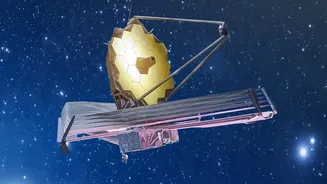
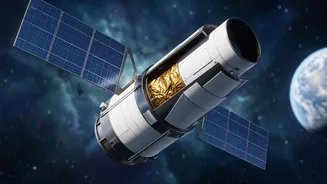
The Nancy Grace Roman Space Telescope is NASA's next great observatory, named after the agency's first chief of astronomy. Launched on August 30, 2026, it is now journeying to its observation point far beyond the Moon. While its primary mirror is the same
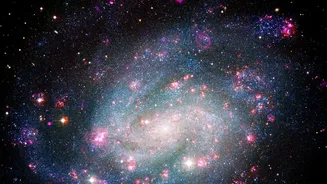
size as the Hubble Space Telescope's, Roman's key advantage is its incredible field of view. Its Wide Field Instrument can capture an area of the sky at least 100 times larger than Hubble can in a single snapshot, all with the same sharp resolution. This makes Roman a survey telescope, designed to map enormous sections of the universe quickly. In its five-year primary mission, it is expected to observe 50 times more sky than Hubble has in over three decades of work.
The Strategic Journey to L2
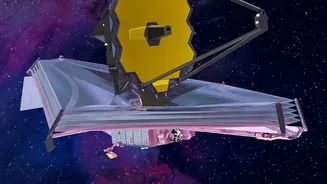
Roman is traveling to the second Sun-Earth Lagrange point, or L2, located about 1.5 million kilometers (930,000 miles) from Earth in the opposite direction of the Sun. This is a special spot in space where the gravitational pull of the Sun and Earth balance out, allowing a spacecraft to maintain a stable orbit with very little fuel. This location also keeps the telescope cold and provides a clear, unobstructed view of the cosmos, away from the light and heat of the Sun, Earth, and Moon. Roman will join the James Webb Space Telescope (JWST) at L2, though they will be in different orbits to ensure they stay far apart. The journey to L2 will take about a month, followed by a commissioning period before science operations begin in early 2027.
Hunting for Dark Energy
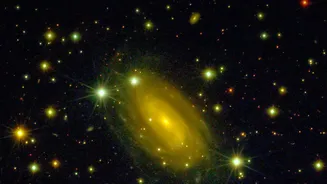
One of Roman's primary goals is to tackle one of the biggest puzzles in modern physics: dark energy. This mysterious force is believed to make up about 70% of the universe and is responsible for causing its expansion to accelerate. Roman will investigate dark energy using three main methods. It will map the distribution of billions of galaxies to see how dark energy has influenced their clustering over time. It will also search for thousands of distant supernovae, or exploding stars, using their predictable brightness to measure cosmic distances and how they have changed. Finally, it will study weak gravitational lensing, where the light from distant galaxies is subtly distorted by the gravity of intervening dark matter, providing a map of this invisible substance and its interaction with dark energy.
A Census of a Billion Stars
Roman's other main objective is to conduct a massive search for exoplanets, or planets outside our solar system. While it will use the transit method to find an estimated 100,000 planets, its true power lies in a technique called gravitational microlensing. This method uses the gravity of a foreground star and its planets to magnify the light of a more distant, background star. This technique is sensitive enough to find planets with masses as small as Mars, worlds in wide orbits, and even 'rogue' planets that drift through space without a host star. This unprecedented planetary census will help scientists understand how common different types of solar systems are and provide new targets for detailed study by other telescopes.
A Wide-Angle Partner to Hubble and Webb
Roman is not a replacement for Hubble or Webb, but a powerful complement to them. Think of it as a wide-angle lens for the cosmos, while Hubble and Webb are zoom lenses. Roman's ability to quickly survey huge patches of the sky will allow astronomers to identify the most interesting targets—be it unusual galaxies, distant supernovae, or promising exoplanet systems. Webb can then perform deep, detailed follow-up observations of these specific targets in the infrared, while Hubble continues its work in visible and ultraviolet light. Together, this family of space observatories will provide both the sweeping cosmic context and the detailed close-ups needed to answer some of astronomy's biggest questions.