



A Cosmic Neighbor with a Violent Past
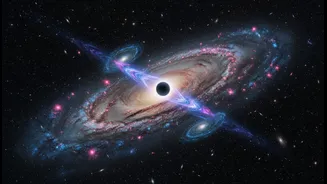
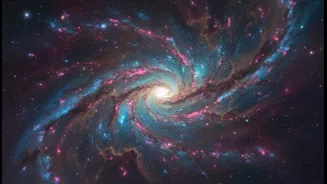
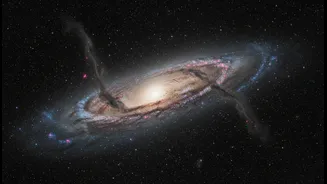
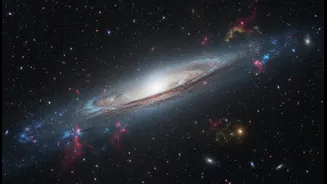
Centaurus A is one of the closest active galaxies to Earth, located about 11 million light-years away. This relative proximity makes it a prime target for astronomers. It's not a placid island of stars; it’s the result of a colossal cosmic collision.
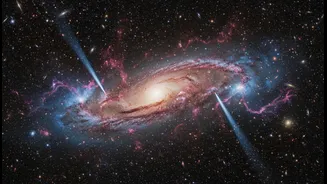
Roughly two billion years ago, a large spiral galaxy and a smaller one merged, creating the unusual, disrupted structure we see today. At its heart lies a supermassive black hole, one that is actively feeding on surrounding gas and dust, and unleashing enormous jets of energy that ripple through the entire galaxy. This combination of a recent merger and an active black hole makes Centaurus A a perfect natural laboratory for understanding how galaxies evolve.
What We Saw Before Webb
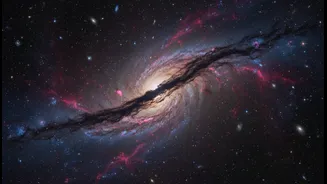
For decades, our best views of Centaurus A came from telescopes like the Hubble Space Telescope. While iconic, these images were fundamentally limited. Hubble primarily sees in visible and ultraviolet light, which is easily blocked by cosmic dust. As a result, the most prominent feature in Hubble’s view of Centaurus A was a thick, dark lane of dust that completely obscured the galaxy's core. Astronomers knew a frenzy of activity was happening behind this dusty curtain, but they couldn't see it in detail. Even earlier infrared observatories like the Spitzer Space Telescope could perceive the larger structures but lacked the sharpness to resolve individual stars or fine details.
Pulling Back the Dusty Curtain
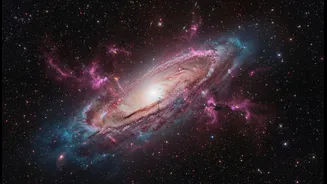
This is where the James Webb Space Telescope represents a monumental leap forward. Using its Mid-Infrared Instrument (MIRI) and Near-Infrared Camera (NIRCam), Webb can peer directly through the dust that blinded Hubble. The result is breathtaking. What was once a dark, obscuring band is now revealed to be a glowing, complex structure of gas and dust. More impressively, Webb resolves the hazy glow into millions of individual points of light, each one a star. For the first time, scientists can see the star-by-star composition of the galaxy's core, a feat essential for piecing together its history.
A Story Written in the Stars
This new, richer view is far more than just a pretty picture; it’s a treasure trove of data. The intricate filaments and glowing clouds of warm dust revealed by MIRI allow astronomers to trace the aftermath of the ancient galactic collision. A mysterious S-shaped structure near the core has also been revealed, which may be linked to the merger or the black hole's activity. By distinguishing between different generations of stars, scientists can perform a kind of galactic archaeology, reconstructing a timeline of events. They can see which stars were part of the original galaxies and which were born in the chaotic burst of star formation triggered by the merger. This level of detail transforms Centaurus A into a vivid record of cosmic history.
The Engine at the Center
Webb’s observations also provide an unparalleled look at the interplay between the supermassive black hole and its host galaxy. Scientists can now see a warped disk of warm hydrogen gas rotating near the core, along with other gas being rapidly pushed outward by the black hole’s immense energy. This addresses a major question in astronomy: how do black holes influence an entire galaxy? The process appears to be a double-edged sword. The black hole’s activity can compress gas to trigger star formation, but it can also blow that same material away, effectively shutting down the birth of new stars. Observing this delicate and violent dance up close in Centaurus A provides crucial clues to how all galaxies across the universe grow and die.