

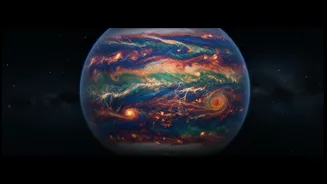


Decoding a Planet's Barcode
Imagine starlight as a pure, white light. When a planet passes in front of its star from our perspective—an event called a transit—a tiny fraction of that light filters through the planet's atmosphere. Each gas in that atmosphere, whether it's water vapour,
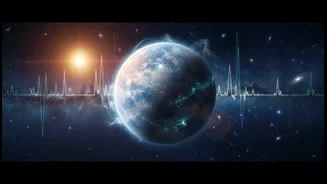
methane, or oxygen, absorbs specific colours or wavelengths of the light. When astronomers look at the starlight that has passed through, certain colours are missing. These missing pieces create a unique pattern of dark lines, much like a barcode. This pattern is the planet's 'atmospheric fingerprint', or more technically, its transmission spectrum. By reading this celestial barcode, scientists can identify the exact chemical elements and molecules present in the atmosphere of a world they can only see as a distant speck.
The Power of Transit Spectroscopy
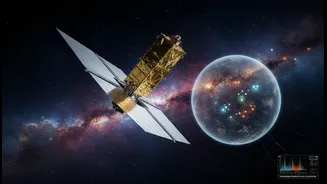
This powerful technique is called transmission spectroscopy. It relies on incredibly sensitive instruments, most notably those aboard the James Webb Space Telescope (JWST), which are designed to detect these minuscule dips in starlight. During a transit, the telescope first measures the spectrum of the star's light alone. Then, as the planet moves in front, it measures the combined light of the star and the light filtering through the planet's atmosphere. By subtracting the first measurement from the second, astronomers are left with the spectral signature of the atmosphere itself. This method has revolutionised exoplanet science, moving us beyond simply detecting planets to beginning to truly characterise them. Recent observations with JWST have successfully identified molecules like carbon dioxide and sulfur dioxide in the atmospheres of distant gas giants.
What These Fingerprints Reveal
An atmospheric fingerprint tells a rich story about a planet. The presence of water vapour, for instance, hints at conditions that could potentially support life. The detection of certain gases like methane can be exciting, though scientists are careful to note they can be produced by geological as well as biological processes. The data can also reveal the planet's temperature, the presence of clouds or hazes, and even the speed of its winds. For example, recent studies of the rocky super-Earth 55 Cancri e with the JWST suggest it has a dynamic atmosphere rich in carbon monoxide, likely being constantly replenished by a molten, volcanic surface. This level of detail, gleaned from trillions of kilometres away, provides crucial insights into the vast diversity of planets that exist in our galaxy.
The Search for Biosignatures
The ultimate goal for many astronomers using this technique is to find a 'biosignature'—a gas or combination of gases that strongly indicates the presence of life. On Earth, the simultaneous presence of oxygen and methane in our atmosphere is a strong fingerprint of life, as these two gases would normally react and destroy each other without living organisms constantly replenishing them. Finding a similar combination on a rocky, Earth-sized planet in its star's habitable zone—the region where liquid water could exist—would be a monumental discovery. However, the scientific community remains cautious. Researchers must rule out all possible non-biological explanations for what they see, a challenge that requires sophisticated models and even more powerful future telescopes. Definitive proof of life may be elusive with current technology, but identifying a planet as a strong candidate for hosting a biosignature would still be a landmark achievement in human exploration.