
The Challenge of Seeing the First Stars
The very first stars to ignite after the Big Bang, known as Population III stars, are a holy grail for astronomers. These celestial bodies are thought to be composed almost entirely of the primordial elements created in the Big Bang—hydrogen and helium.
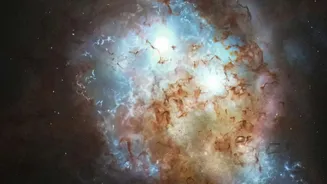
Unlike stars today, they were “metal-free,” meaning they lacked heavier elements like carbon and oxygen. According to theoretical models, these stars were likely enormous, hundreds of times the mass of our Sun, causing them to burn incredibly brightly but for only a few million years before exploding. Their explosive deaths seeded the cosmos with the first heavy elements, paving the way for future generations of stars, planets, and eventually, life. The problem is, because they were so short-lived, all of them died out billions of years ago. Finding them means looking across unimaginable distances and, therefore, back in time.
The Universe's Expanding Canvas
Here's where the first major hurdle appears: the expansion of the universe. Since the Big Bang, the fabric of space itself has been stretching. Think of it like a loaf of raisin bread rising in the oven; the space (dough) between all the raisins (galaxies) expands. As light from a distant, ancient star travels across the cosmos toward us, the space it's moving through stretches, and this stretching has a profound effect on the light itself. The light's wavelength gets stretched out along with space. This phenomenon is called “cosmological redshift.” Light that was originally emitted as high-energy ultraviolet or visible light from a first-generation star has been stretched so much over its 13-billion-year journey that by the time it reaches Webb's mirrors, it has shifted all the way down the electromagnetic spectrum into infrared light.
Infrared: Peering Through the Cosmic Fog
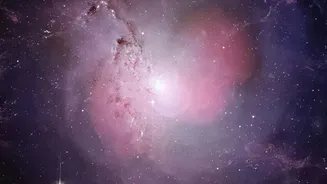
Redshift isn't the only reason infrared is crucial. The universe, especially regions where new stars are forming, is filled with vast clouds of cosmic dust and gas. To a telescope that sees in visible light, like the human eye or even parts of the Hubble Space Telescope's range, these dust clouds are opaque, like a dense fog. Shorter wavelengths of light, such as blue and ultraviolet, are easily scattered and absorbed by tiny dust particles. However, longer wavelengths—like infrared—can slip past the dust grains more easily. This allows infrared telescopes to peer through the cosmic nurseries that would otherwise hide forming stars and ancient galaxies. By detecting infrared, Webb essentially has X-ray vision for the cosmos, revealing what is hidden behind curtains of dust.
Webb’s High-Tech Infrared Eyes
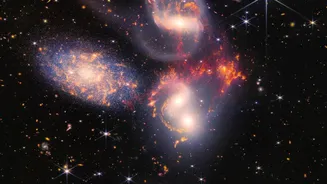
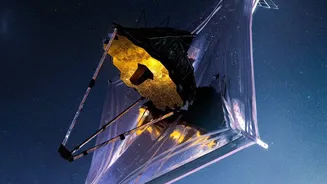
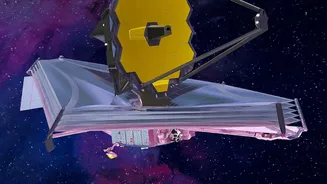
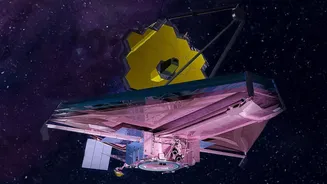
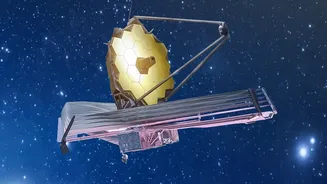
To capture this faint, ancient, and stretched-out light, the JWST is equipped with a suite of highly sensitive instruments designed specifically for infrared detection. Its primary imager, the Near-Infrared Camera (NIRCam), is the key to spotting the light from the earliest stars and galaxies. It operates in the near-infrared range, from 0.6 to 5 microns, precisely the part of the spectrum where the light from the most distant objects is expected to appear. Supporting NIRCam are other instruments like the Mid-Infrared Instrument (MIRI), which sees even longer, cooler infrared wavelengths, ideal for observing dust-shrouded newborn stars and planets. Together, these instruments function like a highly advanced set of night-vision goggles, cooled to incredibly low temperatures to ensure their own heat doesn't interfere with the faint signals they are trying to detect from the dawn of time.