




A Glimmer in the Darkness
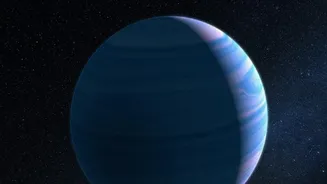
The latest addition to Uranus's family of moons, provisionally named S/2025 U1, was discovered using the powerful James Webb Space Telescope (JWST). An international team of scientists captured a series of long-exposure images of the planet. By combining
these images, they could filter out the glare from Uranus itself and reveal much fainter objects nearby. In these carefully processed pictures, a tiny, previously unknown dot of light appeared, moving in sync with the planet against the backdrop of distant stars. This initial detection is the crucial first step, turning an empty patch of sky into a location of intense scientific interest. This particular moon is estimated to be only about 10 kilometres in diameter, making it far too small to have been seen by the Voyager 2 spacecraft during its 1986 flyby.
The Art of Tracking a Wobble
Finding the dot is one thing; proving it’s a moon is another. The key is to demonstrate that the object is gravitationally bound to the planet. Scientists must track its movement over time. This involves taking multiple images over several nights, and sometimes even months or years. By plotting the object's position relative to Uranus in each image, they can trace its path. If the object is moving at a speed consistent with Uranus’s gravitational pull for its distance, it is very likely a moon. This process is similar to the radial velocity method used to find exoplanets, where astronomers look for the “wobble” a planet induces in its host star. In this case, they are directly observing the moon's motion around its host planet.
Calculating the Cosmic Dance
Once enough observations are collected, the real number-crunching begins. Astronomers use the data points to calculate a preliminary orbit. This process relies on the fundamental laws of gravity and motion first described by Johannes Kepler and Isaac Newton centuries ago. They create a computer model that predicts the moon’s path, taking into account the immense gravity of Uranus and the smaller gravitational pulls from its other 28 moons. The model must accurately match the observed positions. If the model holds up and can predict where the moon will be in future observations, scientists can be confident they have determined its orbit. This includes its shape (usually an ellipse), its tilt relative to the planet's equator, and how long it takes to complete one full circle, known as its orbital period.
Making It Official: Identity and a Name
With a well-defined orbit, the discovery is submitted to the Minor Planet Center, which is part of the International Astronomical Union (IAU). The IAU is the global body responsible for naming celestial objects. They review the data and, upon verification, grant the object a provisional designation, like S/2025 U1. The 'S' stands for satellite, '2025' for the year of discovery, and 'U1' for the first such object found orbiting Uranus that year. Later, once the orbit is confirmed with absolute certainty, the discovery team gets to propose a permanent name. Keeping with tradition, the moons of Uranus are named after characters from the works of William Shakespeare and Alexander Pope, making it the only planet with a literary, rather than mythological, naming scheme.
Why These Tiny Discoveries Matter
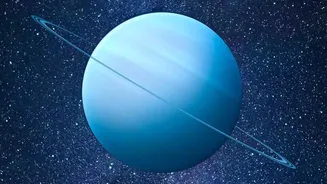
Discovering a small, faint moon might not seem as dramatic as finding a new planet, but these tiny worlds are crucial pieces of the solar system puzzle. They act as historical artifacts, offering clues about the formation and evolution of the Uranian system. Some moons are thought to be captured asteroids or comets, while others may have formed from the same disk of gas and dust that created the planet itself. The odd 98-degree tilt of Uranus, possibly caused by a massive ancient collision, makes its moon system particularly intriguing. Studying the orbits and compositions of these moons, especially how they interact with the planet's faint rings, helps scientists piece together the violent and dynamic history of our outer solar system.