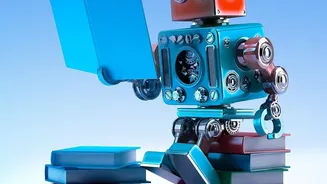








The New Study Partner
At its core, an AI study tool is a software application that uses artificial intelligence to process educational content and automatically generate learning materials. Think of it as a tireless assistant that can read through pages of your uploaded documents—like
PDFs of textbook chapters or lecture notes—and understand the key information. Using technology called natural language processing, these tools identify important terms, core concepts, and essential facts buried in the text. The goal is to move beyond passive re-reading, which has been shown to be less effective, and embrace active learning. By turning static information into interactive materials, AI helps you engage directly with the content, test your knowledge, and pinpoint areas that need more attention.
From Text to Interactive Flashcards
One of the most popular features of these AI tools is their ability to create flashcards instantly. Instead of manually writing out dozens of cards, you simply upload your material. The AI then scans the document and generates question-and-answer style flashcards. For instance, if you upload a chapter on cell biology, the tool can create cards for key terms like 'mitochondria' or concepts like 'photosynthesis'. Some advanced platforms like RemNote and StudyGlen even allow for more complex formats and can generate cards from images or YouTube videos. This automation saves hours of tedious work, allowing students to spend more time on what actually matters: practicing and memorizing the material.
Self-Assessment with AI Quizzes
Beyond flashcards, many AI study tools can generate practice quizzes from your study materials. These aren't generic tests; they are tailored specifically to the content you provided. You can get multiple-choice questions, fill-in-the-blanks, and short-answer prompts based on your textbook chapter. This process reinforces learning through a method called active recall, which is proven to strengthen memory retention. Tools like Quizlet and Google's NotebookLM can turn your notes and readings into adaptive practice questions, sometimes even adjusting the difficulty based on your performance. This allows for a personalized practice session that focuses on your specific weaknesses, making your study time far more efficient.
Popular Tools to Get Started
The market for AI study aids is growing fast. Quizlet, a long-time favourite, now uses AI to turn notes into flashcards and practice tests. Google's NotebookLM is a powerful free tool that lets you upload your source materials (PDFs, docs, even YouTube videos) and then generate summaries, guides, and flashcards based only on that content. For students looking for integrated systems, platforms like RemNote and StudyGlen combine note-taking with AI-powered flashcard generation and spaced-repetition scheduling, a technique that prompts you to review information right before you're likely to forget it.
A Word of Caution
While incredibly useful, AI study tools are not infallible. The information they generate is only as good as the data they are trained on and the material you provide. Surveys have shown that a majority of students believe AI can provide inaccurate or overly simplified answers. These tools are best seen as a supplement to, not a replacement for, traditional learning. They can't replicate the critical thinking, emotional intelligence, or passion that a human teacher provides. It's crucial for students to cross-verify the AI-generated content and continue to engage deeply with their coursework rather than simply offloading the work to an algorithm. Use these tools to augment your learning, not as a shortcut.