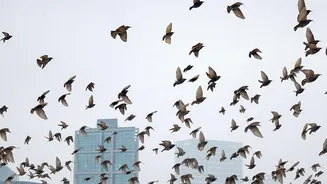








You’ve seen it: a swirling, mesmerising cloud of birds moving as one across the city sky at dusk. This breathtaking sight is more than just a random gathering; it’s a vital sign of a massive, ancient journey unfolding right above our heads.
An Ancient Rhythm of Survival
At its core,
bird migration is a survival strategy hardwired into hundreds of species. Birds travel, sometimes thousands of kilometres, on predictable seasonal schedules. They move from areas where resources are becoming scarce to regions where food is abundant and conditions are right for breeding. In the Northern Hemisphere, as winter approaches and temperatures drop, food sources like insects disappear, prompting a mass exodus south to warmer climates. India, with its tropical and subtropical weather, becomes a crucial wintering ground for millions of these avian travellers.
India's Great Avian Highway
India is perfectly positioned along the Central Asian Flyway (CAF), one of the world's nine major migratory superhighways. This route stretches from the freezing Arctic and Siberia down through Central Asia and into the Indian subcontinent. Over 370 migratory species use this path, and India provides critical stopover sites for more than 90% of them. This makes the country an essential service station on a gruelling intercontinental flight. Birds aren't just passing through; they depend on India's wetlands, grasslands, and coastal habitats to rest and refuel before continuing their journey or settling in for the winter.
Who Are These Winged Travellers?
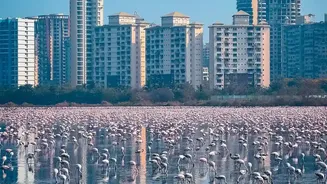
The massive flocks you see are often made up of a few key species. Rosy starlings, for instance, travel from Eastern Europe and Central Asia in enormous, noisy flocks that can seem to turn the sky into a shimmering cloud. Another famous high-flyer is the bar-headed goose, which undertakes one of the most extreme migrations on Earth by flying over the Himalayas at staggering altitudes to reach the wetlands of northern India. You might also spot various ducks, waders, and raptors, each undertaking an epic journey. Even cities like Mumbai become temporary homes for thousands of Greater Flamingos, which turn the Thane Creek mudflats pink.
Why Your City is on Their Map
It may seem counterintuitive for wild birds to fly over bustling, noisy cities, but there are clear reasons. Many Indian cities were historically built along rivers, lakes, or coastlines—the very same natural corridors that birds have used as navigational guides for millennia. Furthermore, urban green spaces like city parks, large lakes, and protected wetlands can act as oases in a concrete desert. These spots offer a place to rest and find food, making them vital stopover points. However, cities also present new dangers. Artificial light from buildings can disorient birds that migrate at night, leading to confusion and collisions with glass facades. The 'urban heat island' effect can also alter migration timing.
A Murmuration: Safety in Numbers
The beautiful, coordinated swirling you see, especially from starlings, is called a murmuration. This isn't just for show; it's a powerful defense mechanism. At dusk, when predators like falcons are most active, a single bird is an easy target. But a constantly shifting, tightly packed flock of thousands makes it nearly impossible for a predator to single out and attack one individual. With no single leader, each bird reacts almost instantly to the movements of its closest neighbours, creating a fluid, unified super - organism that moves with breathtaking grace for collective survival.