




The Dawn of Interplanetary Broadband
Imagine trying to send a high-definition movie to a friend using the internet from the 1990s. That’s essentially the challenge NASA has faced for decades with deep space communication. Radio-frequency systems, the long-standing workhorse of space exploration,
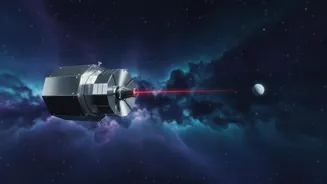
have been reliable but are reaching their limits. As missions become more complex and generate vast amounts of data—from high-resolution images to sophisticated scientific readings—the need for a faster, more efficient data pipeline has become critical. This is where optical, or laser, communication comes in. Instead of using radio waves, this technology encodes data onto beams of near-infrared light. Because light has a much higher frequency than radio waves, it can carry significantly more information in a single transmission. This leap in bandwidth is poised to upgrade our connection to the cosmos from a slow trickle to a high-speed torrent, enabling possibilities once confined to science fiction.
NASA's Psyche Mission and the DSOC Experiment
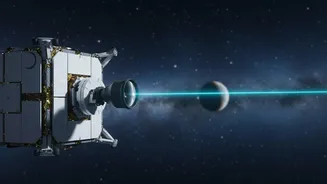
The technology making headlines is part of an experiment called Deep Space Optical Communications (DSOC), which is hitching a ride on NASA’s Psyche spacecraft. Launched in October 2023, the Psyche mission is on a long journey to a unique metal-rich asteroid located between Mars and Jupiter. While the spacecraft’s main goal is to study the asteroid, it is also serving as a testbed for the DSOC system. The experiment consists of a sophisticated laser transceiver on the spacecraft, a powerful uplink transmitter on the ground in California, and a highly sensitive receiver at Caltech's Palomar Observatory. The goal was to prove that laser communications could work over the immense distances of deep space, something that had never been done before beyond the Moon. The experiment has been a resounding success, far exceeding its initial objectives and proving the technology is ready for future missions.
Just How Much Faster Is It?
The performance of the DSOC system has been nothing short of revolutionary. In one of its early tests, the system beamed an ultra-high-definition video of a cat named Taters from 19 million miles away. The transmission achieved a maximum speed of 267 megabits per second (Mbps), a rate comparable to many home broadband internet connections. To put that in perspective, this is 10 to 100 times faster than the most advanced radio-frequency systems currently used on deep space missions. Even as the Psyche spacecraft traveled farther out, to distances comparable to Mars's farthest point from Earth, the laser system continued to transmit data at impressive speeds. From 249 million miles away, it still managed a rate of 8.3 Mbps. While this is slower than the peak speed, it's still significantly faster than what a similar radio system could achieve over that same vast distance.
Paving the Way for Martian Livestreams
This technological leap is not just about faster downloads; it's a critical enabler for the future of human exploration. When astronauts eventually travel to Mars, they will need reliable, high-bandwidth communication for everything from sending back high-definition video of their discoveries to receiving critical mission data and even keeping in touch with loved ones on Earth. Laser communications can provide that capacity. It will allow scientists to receive huge volumes of data from advanced instruments in a fraction of the time it currently takes, accelerating the pace of discovery. The Mars Reconnaissance Orbiter, for example, can take over seven hours to transmit the contents of its onboard recorder; a laser system could do it much faster. This technology essentially lays the groundwork for an interplanetary internet, a network that will support a sustained human presence on the Moon, Mars, and beyond.
Overcoming the Challenges of Cosmic Aim
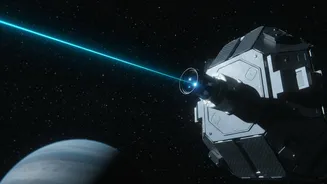
Sending a laser beam across millions of kilometres to hit a target just a few metres across is an immense technical challenge. The beam is incredibly narrow, which requires pointing accuracy on the level of microradians—a measurement of an incredibly small angle. To achieve this, the ground station fires a powerful laser beacon toward the spacecraft, which the transceiver on Psyche then locks onto to perfectly aim its return beam. Another challenge is the Earth's atmosphere, as clouds can disrupt the laser signal. This is why NASA’s optical ground stations are located in areas known for clear skies, like California and Hawaii. Future systems may involve a network of ground stations around the globe to ensure there’s always a clear line of sight to a receiving telescope.