

The Ultimate Survival Challenge
Sending humans to Mars is one of the greatest technological challenges of our time. But keeping them alive once they arrive is an entirely different problem. The cost and complexity of shipping every meal, every litre of water, and every piece of equipment
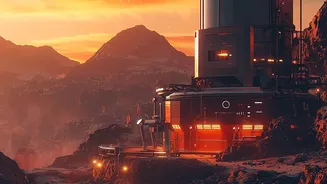
from Earth are astronomical. For any long-term habitat to be viable, future astronauts must learn to live off the land. This principle, known as in-situ resource utilization (ISRU), is the cornerstone of sustainable space exploration. It means turning the raw, alien materials of Mars—its soil, atmosphere, and ice—into breathable air, drinkable water, and usable building supplies. Before humanity can build a future on the Red Planet, it must first solve the fundamental question of how to fend for itself millions of miles from home.
From Toxic Soil to Fertile Ground
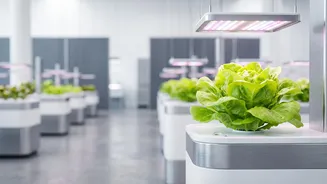
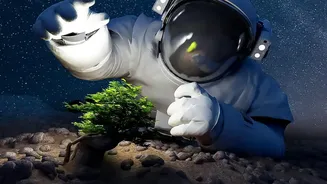
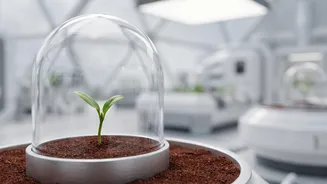
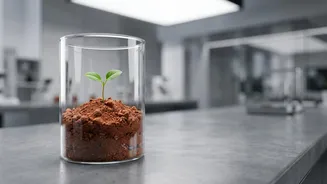
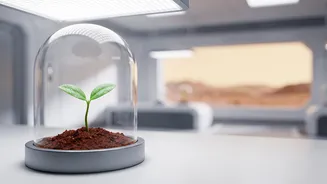
One of the most critical resources for any settlement is food, and Martian soil presents a major obstacle. The loose material covering the planet, known as regolith, is laced with toxic compounds called perchlorates and lacks the organic matter needed for agriculture. This is the problem that a team of three Texas students decided to solve. Varshini Gandreddy, Dhiti Koyya, and Raaga Bukkaraju designed a concept called Gaia's Outpost for the Conrad Challenge, an innovation competition. Their system proposes a way to process the toxic Martian regolith, neutralizing the harmful chemicals and turning it into a fertile medium for growing crops. Their project, which won an award at the 2026 Innovation Summit at Space Center Houston, offers a potential solution to one of the biggest roadblocks to self-sufficiency on Mars.
More Than Just a Meal
The students' vision for Gaia's Outpost extends beyond simple sustenance. They argue that the ability to grow fresh food locally would not only reduce a mission's dependence on resupply from Earth but also provide a significant psychological boost for astronauts. In the barren and isolated environment of a Martian habitat, the presence of living, growing plants could be a crucial link to home, improving mental health and morale during long-duration stays. The team even developed a business plan for their concept, estimating a potential market among government space agencies and private aerospace companies planning future Mars missions. While still a student concept, their work demonstrates a holistic approach to a complex engineering problem, considering both the physical and human factors of life on another world.
A Pattern of Innovation
This focus on solving Mars's fundamental survival questions is not an isolated incident. In Minnesota, another student, Jeremiah Bents, tackled a different but equally vital resource: water. For his award-winning science fair project, Bents investigated whether a laboratory simulant of Martian soil could be used to filter ammonia from contaminated water. His experiment, which brought a planetary science question into a school lab, explored another facet of ISRU. Mentored in part by a NASA scientist, his project shows how foundational questions about living on Mars can be broken down into testable experiments here on Earth. From growing food to purifying water, these student-led initiatives highlight a growing trend where the next generation of scientists and engineers are not just dreaming of Mars, but are actively doing the work to make it possible.
The Next Generation of Explorers
For years, NASA and other organizations have encouraged this kind of forward-thinking through various challenges and educational programs. Competitions like the Robotic Mining Competition and the Mission to Mars Student Challenge effectively crowdsource innovative ideas from bright minds in schools and universities across the country. These programs serve a dual purpose: they generate novel solutions to real-world space exploration problems and inspire a new generation to pursue careers in science, technology, engineering, and math. The work of students like the Gaia's Outpost team and Jeremiah Bents proves that you do not need to be a senior NASA engineer to contribute to the journey to Mars. The foundational work is already being done in classrooms and science fairs, one brilliant idea at a time.