




In the quest to understand the universe, some of the biggest clues are found in the smallest places. Physicists are now 'knocking on the door' of a new realm, the 'zeptoverse,' after finding evidence of a particle decay sought for over 40 years.
A Prize Decades in the Making
Scientists
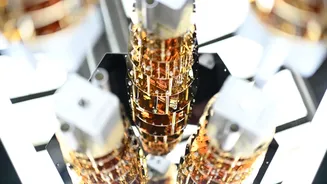
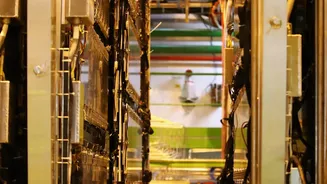
at CERN's Large Hadron Collider (LHC) have announced the first single-experiment evidence for an astonishingly rare event: the decay of a neutral B meson (B0) into two muons. This process is so infrequent that the Standard Model of particle physics—our current best theory of fundamental particles—predicts it happens only about once in every 10 billion decays. After a search spanning more than four decades, the LHCb experiment, which specialises in studying particles containing 'beauty' quarks, captured the signal. Upgrades to the detector and the use of machine learning to filter out background noise were crucial in isolating this faint signal from the torrent of data produced by particle collisions.
Entering the 'Zeptoverse'
The term 'zeptoverse' is a catchy, informal name physicists use to describe the world at the scale of a zeptometre—a billionth of a trillionth of a metre (10⁻²¹ m). This is a frontier far smaller than anything we can observe directly. The LHC itself smashes protons together to probe distances down to about 100 zeptometres. The significance of this new measurement is that it provides an indirect way to search for phenomena at even smaller scales. By precisely measuring a very rare process, scientists can look for tiny deviations from what the Standard Model predicts. Such a deviation could be the signature of a new, undiscovered particle or force influencing the decay through quantum effects. Even though no new particles were directly created, their existence could subtly change the decay's probability.
So, Is This 'New Physics'?
Not yet. In fact, the result is currently in agreement with the predictions of the Standard Model. While that may sound less exciting than discovering a completely new particle, it is still a vital piece of the puzzle. Confirming a prediction at this level of rarity is a powerful validation of the theory. It also allows scientists to place stricter limits on the properties of hypothetical new particles. If new physics were strongly influencing this decay, the rate would likely be different from what was observed. Because the measurement aligns with the prediction, it narrows the 'room' where new physics might be hiding. The goal is to keep improving the measurement's precision to see if a discrepancy emerges.
Evidence, Not Discovery
The headline's caution about 'independent checks' is a crucial part of the scientific process. In particle physics, results are measured by their statistical significance, or 'sigma'. A result with a significance of 3 sigma is considered 'evidence', meaning there is only a small chance it is a random statistical fluke. To claim a 'discovery', the gold standard is 5 sigma, which means the probability of a fluke is about one in 3.5 million. The new result, combining data from 2011 to 2025, has a significance of 3.2 sigma—comfortably past the threshold for evidence but not yet a discovery. Reaching the 5-sigma level will require more data from the LHC's future runs, which are expected to increase data collection rates significantly. This painstaking process of verification ensures that when a discovery is finally announced, the scientific community can be extremely confident in its validity.