

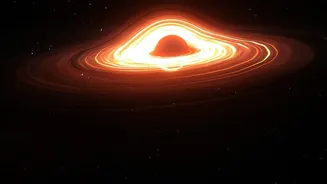
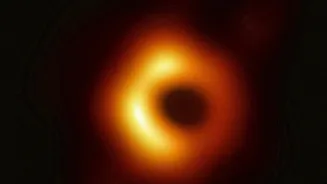

The Milky Way is thought to host 100 million black holes, yet we've found fewer than 100. Closing that gap seems impossible, but astronomers now have a secret weapon: an army of volunteer 'citizen scientists' helping to hunt them down from home.
A Universe of Data
Modern
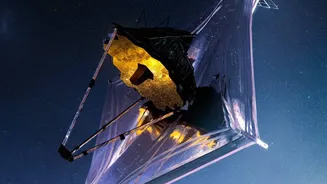
astronomy is drowning in data. Telescopes like NASA’s Transiting Exoplanet Survey Satellite (TESS) and the European Space Agency's Euclid mission scan the skies constantly, generating more information than teams of professional scientists can ever hope to analyse. For instance, the SuperWASP survey, a project designed to detect planets outside our solar system, created an archive of measurements from over ten years of observations. Sifting through these vast datasets for rare and specific signals is like searching for a needle in a cosmic haystack. This is where the power of the public comes in, turning a data problem into a story of collaborative discovery.
Enter the Black Hole Hunters
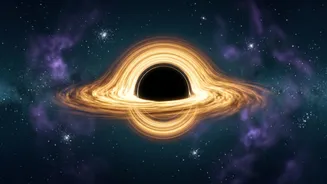
Projects like 'Black Hole Hunters,' hosted on the citizen science platform Zooniverse, invite anyone with a computer to join the search. The goal is to find stellar-mass black holes that are otherwise invisible. Most known black holes are found because they are 'feeding' on nearby material, which heats up and emits detectable X-rays. The Black Hole Hunters project looks for dormant black holes, which are much harder to spot. Volunteers are shown graphs representing the brightness of a star over time, taken from surveys like SuperWASP or TESS. They don't need a degree in astrophysics; they just need to learn to recognise a specific pattern.
Spotting the Unseeable
The technique relies on a phenomenon predicted by Einstein: gravitational lensing. A massive object, like a black hole, has gravity so strong it can bend and magnify the light from an object directly behind it. The project specifically looks for black holes in binary systems, where a black hole orbits a regular star. If the alignment is just right from our perspective on Earth, the black hole will periodically pass in front of its companion star. As it does, its gravity acts like a magnifying glass, causing the star's light to briefly and symmetrically flare before returning to normal. This creates a distinct peak in the star's light curve—a tell-tale sign that an invisible, massive object is present. It's a job where the human eye for pattern recognition often outperforms an automated algorithm.
The Democratization of Discovery
Black Hole Hunters is part of a larger, flourishing movement in astronomy. Projects like 'Space Warps' use citizen scientists to find gravitational lenses in data from the Euclid telescope to study dark matter. Others, such as 'Backyard Worlds: Planet 9' and 'Planet Hunters TESS', have led to the discovery of new brown dwarfs and exoplanets, with volunteers often being named as co_authors on the resulting scientific papers. These initiatives do more than just accelerate research; they democratize it. They provide a direct link between the public and the frontiers of science, allowing anyone with curiosity to contribute to our understanding of the universe. According to project leaders, the work of volunteers is crucial for training machine learning models that will speed up the search even more in the future.