



What is a Nebula?
At its most basic, a nebula is a giant cloud of gas and dust floating in the space between stars. The word itself comes from Latin, meaning 'cloud' or 'mist'. For a long time, early astronomers used the term for any fuzzy, indistinct object in the night
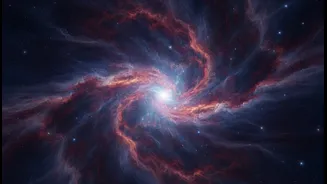
sky, including distant galaxies. We now know they are distinct phenomena within our own galaxy. These clouds are primarily made of hydrogen and helium, the most common elements in the universe. While they can be enormous, stretching for many light-years, their density is incredibly low. A piece of a nebula the size of our entire planet would only weigh a few kilograms. They are the fundamental building blocks for new stars and planetary systems and the beautiful graveyards of stars that have reached the end of their lives.
Stellar Nurseries in Glowing Gas
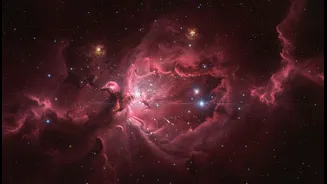
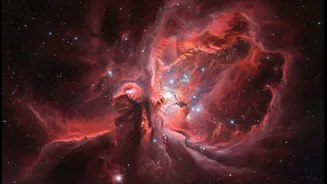
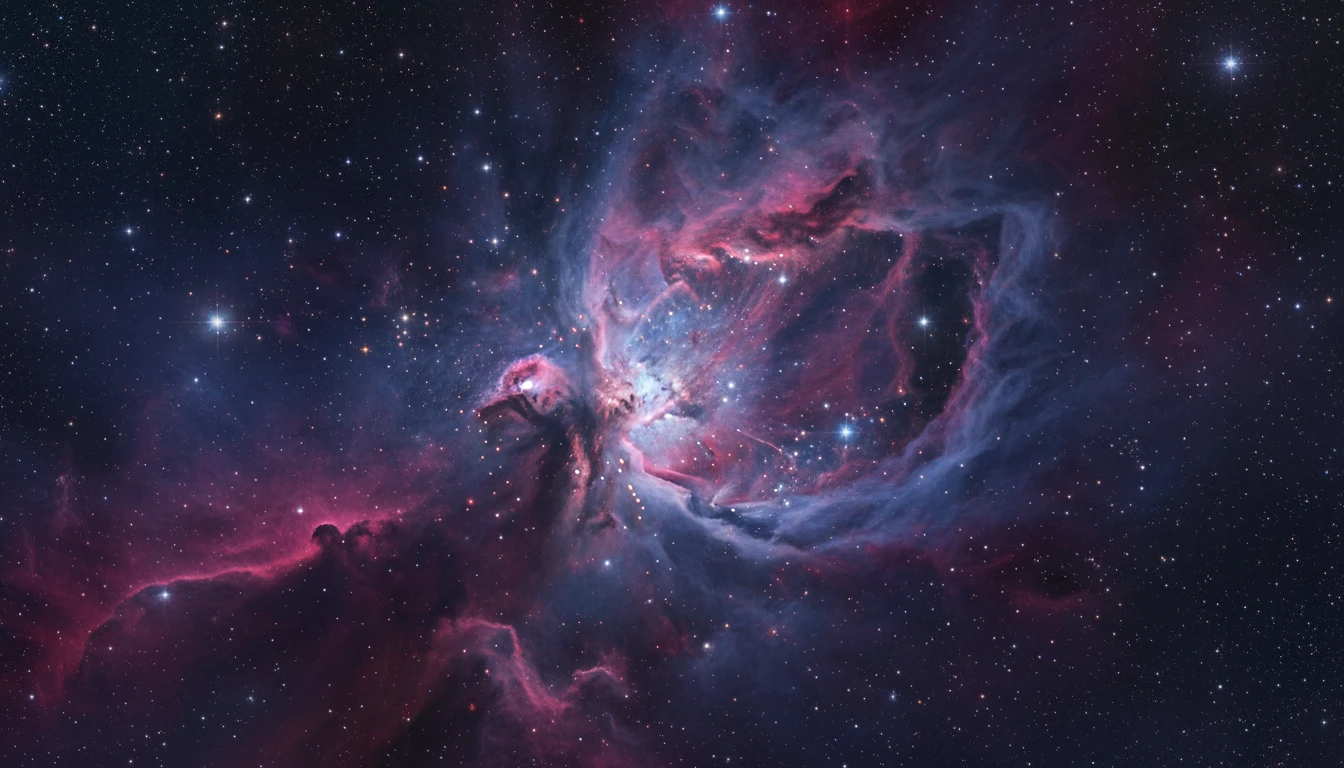
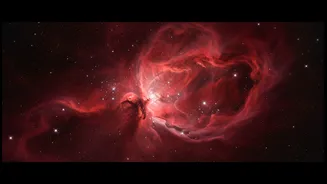
Many of the most famous and colourful nebulae are what scientists call 'emission nebulae'. Think of them as stellar nurseries, where new stars are actively being born. A prime example is the Orion Nebula, a stunning cloud visible to the naked eye just below the belt of the Orion constellation. Inside these clouds, gravity slowly pulls clumps of gas and dust together. As these clumps grow denser, they heat up, forming a protostar. Eventually, the core becomes so hot and dense that nuclear fusion ignites, and a star is born. The intense ultraviolet radiation from these powerful young stars then causes the surrounding gas to glow, much like a neon sign, creating the vibrant reds and pinks we see in images. This glow is often from energized hydrogen gas.
The Beautiful End of a Star's Life
Nebulae are not only about birth; they are also about death. When a star similar in size to our Sun runs out of fuel, it doesn't explode violently. Instead, it puffs off its outer layers of gas into space. This expanding shell of gas is then illuminated by the hot, dying core of the star left behind, now a white dwarf. This creates a 'planetary nebula'. The name is a historical misnomer; they have nothing to do with planets but were named because their round shapes looked like planets through early telescopes. The famous Ring Nebula is a classic example of this process, a beautiful, ghostly ring that is the final farewell of a dying star. For stars much more massive than the Sun, the end is far more dramatic. They explode in a supernova, blasting material out into space at incredible speeds. This creates a 'supernova remnant', like the famous Crab Nebula, whose explosion was seen from Earth in the year 1054.
Cosmic Shadows and Reflected Light
Not all nebulae glow with their own light. Some are so dense with cold gas and dust that they block the light from stars or bright nebulae behind them. These are known as 'dark nebulae' or 'absorption nebulae'. They appear as dark patches or silhouettes against the star-filled backdrop of the Milky Way. The Horsehead Nebula is perhaps the most iconic example, its familiar shape visible only because it stands out against a glowing red emission nebula behind it. Another type, the 'reflection nebula', doesn't produce its own light but shines by reflecting the light of nearby stars. Since blue light scatters more easily than red light, these nebulae often have a characteristic ghostly blue hue, similar to why Earth's sky is blue.
Decoding the Colours of the Cosmos
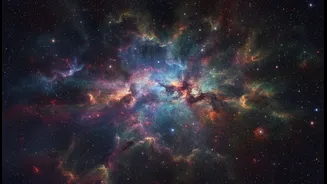
Those spectacular colours you see in images from the Hubble or James Webb Space Telescopes are not just for show; they carry scientific information. Astronomers often use special filters to isolate light emitted by specific chemical elements. The resulting images are then assigned colours, a process sometimes called 'false colour' imaging. A common practice, known as the Hubble Palette, maps light from sulphur to red, hydrogen to green, and oxygen to blue. This allows scientists to see the distribution of different elements within the nebula and understand the physical processes happening inside. The common reddish-pink hue in many 'true colour' images comes from hydrogen, the most abundant gas, being energized. Blues and greens often indicate the presence of oxygen. By translating this invisible data into colours we can see, astronomers turn these beautiful images into detailed maps of cosmic creation and destruction.