


A New Eye on the Dark Universe
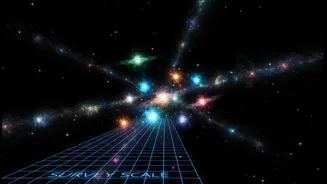
Launched in July 2023, the Euclid mission's primary goal is to unravel the biggest mysteries in cosmology: dark matter and dark energy. These enigmatic components are believed to make up about 95% of the universe, yet they remain invisible. To map their
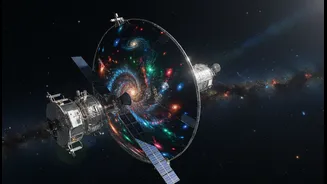
influence, Euclid is charting the 3D structure of the universe by observing billions of galaxies up to 10 billion light-years away. It does this with two key instruments: one that captures sharp images in visible light and another that measures distances using near-infrared light. This allows it to create the largest, most detailed map of the cosmos ever attempted, revealing how the universe has expanded and how its structure has evolved over time.
Hunting for Cosmic Lighthouses
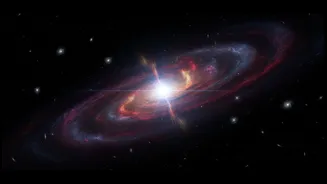
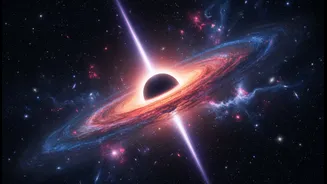
To look back to the universe's infancy, astronomers need incredibly bright light sources. The "oldest beacons" in the headline refer to quasars—extraordinarily luminous objects powered by supermassive black holes at the centers of young galaxies. As gas and stars are pulled into a black hole, the material forms a superheated disk that can shine with the light of a trillion suns, outshining its entire host galaxy. This immense brightness makes quasars visible across billions of light-years, acting as cosmic lighthouses that illuminate the very early universe. Finding them helps astronomers understand one of the biggest puzzles in astrophysics: how supermassive black holes grew to such enormous sizes so quickly after the Big Bang.
The Power of a Wider View
This is where Euclid’s “wide-sky power” becomes a game-changer. While telescopes like Hubble and JWST take incredibly deep, narrow-field images, Euclid is a survey instrument. It captures images with Hubble-like sharpness but over an area 270 times larger in a single pointing. This allows it to scan vast regions of the sky efficiently, a crucial capability for finding extremely rare objects like ancient quasars. In a recent discovery, Euclid identified 31 new quasars from the universe's first billion years, more than doubling the number previously known from that era. It took over a decade for other telescopes to find the first ten or so; Euclid found more than that in its first year. This haul included a new record-holder: the most distant quasar ever seen, whose light comes from just 670 million years after the Big Bang.
Rewriting the First Cosmic Chapter
Finding a large population of these early quasars is about more than just breaking records. It provides the first real 'census' of these objects, allowing scientists to study the typical quasar from this era, not just the brightest and rarest outliers. These discoveries provide crucial data for understanding the "Epoch of Reionization," a key period when the first stars and galaxies lit up, burning off the fog of neutral hydrogen that filled the early universe. By studying the light from these quasars, scientists can probe the conditions of this transformative period. The sheer number and early formation of these massive black holes challenge existing models of cosmic evolution, suggesting that the first black holes may have been born with significant mass, a mystery that missions like Euclid are now equipped to investigate.