

A Storm Unlike Any on Earth
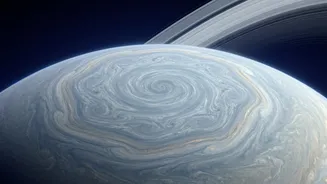
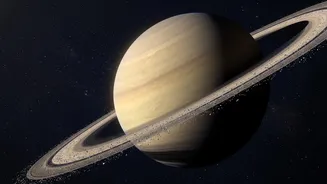
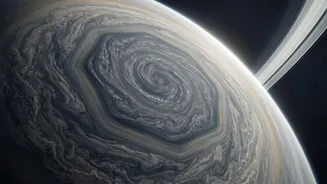
At Saturn's south pole churns a vast, permanent vortex. Think of a hurricane, but on a scale almost unimaginable to us. The 'eye' of this storm alone is about 8,000 kilometres across, roughly two-thirds the diameter of Earth itself. While polar vortices
exist on other planets, including our own, Saturn's southern one is a different beast entirely. Unlike terrestrial hurricanes that are born over warm oceans and drift across the surface, this vortex is fixed to the pole and is powered by the planet's internal atmospheric dynamics, not a body of water. Data from NASA's Cassini spacecraft revealed towering cloud walls and wind speeds reaching a staggering 150 metres per second. It's a permanent fixture of the planet, a storm that has been raging for as long as we have been able to observe it.
The Paradox of the Hot Pole
One of the most baffling features of the south polar vortex is its temperature. Logic suggests a planet's pole, especially one tilted away from the sun for long periods, should be cold. Yet, Saturn's south pole is home to the warmest temperatures on the entire planet. When the Cassini spacecraft arrived, the southern hemisphere was in its summer, so some warmth was expected. But scientists discovered an abrupt temperature spike close to the pole that seasonal sunlight alone couldn't explain. This created a 'hot spot' right at the centre of the vortex. The leading theory is that as air from other parts of the planet is drawn towards the pole, it descends into the atmosphere. This descent compresses the gas, causing it to heat up significantly, creating a warm core where a cold one should be. This is the first warm polar cap ever discovered in our solar system.
A Tale of Two Poles
The mystery deepens when you compare Saturn's south pole to its north pole. The north pole is famous for its bizarre, near-perfect hexagon—a six-sided jet stream that has remained stable for decades. For years, scientists expected to find a similar geometric pattern at the south pole. However, observations from the Cassini mission showed no such structure. The south pole had a powerful, circular vortex, but no hexagon. This stark difference suggests that the two poles, despite being on the same planet, have very different atmospheric dynamics. The forces that create and maintain the stable hexagon in the north are not at play in the same way in the south, which instead features a more singular, hurricane-like cyclone.
A New Shape Emerges
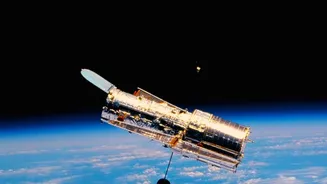
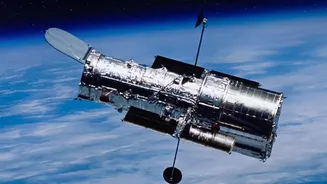
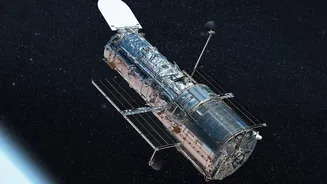
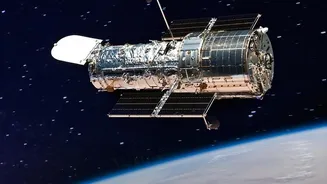
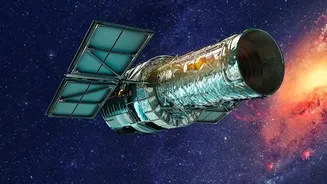
Just when scientists thought they understood the south pole's character, recent observations have added a new twist. As Saturn's southern pole has tilted back towards Earth in the last few years, the Hubble Space Telescope has spotted something new forming. Between 2023 and 2025, astronomers identified an enormous, 10-sided atmospheric wave—a 'decagon'—materializing in the southern hemisphere. This is not a solid structure but a repeating bend in a powerful jet stream. Unlike the stable northern hexagon, this southern feature appears to be newer and possibly less stable. Its recent formation, after being absent during the entire Cassini mission, suggests scientists might be witnessing the birth of a massive planetary weather pattern in real-time, raising new questions about why it is forming now and what it tells us about Saturn's changing seasons.