






The Cosmic Hunt for Water
For astronomers, the mantra is simple: follow the water. Life as we know it requires liquid water to thrive, making its presence a key indicator of potential habitability on other planets. Finding it, however, is a monumental challenge. Exoplanets are
incredibly distant and faint, mere specks of dust next to the glare of their parent stars. Directly spotting an ocean is currently impossible. Instead, scientists have become cosmic detectives, searching for tell-tale clues hidden in starlight. The most crucial of these clues is water vapour, the gaseous form of water that can linger in a planet's atmosphere.
Reading a Planet's Breath
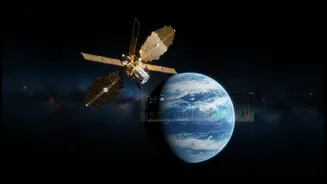
So how do you read the atmosphere of a planet you can’t even properly see? The primary method is called transit spectroscopy. As an exoplanet passes in front of its star from our point of view, a tiny fraction of the starlight filters through the planet’s atmosphere. Molecules in that atmosphere absorb specific wavelengths, or colours, of light. Every chemical, from methane to carbon dioxide, leaves a unique spectral “fingerprint” or “barcode” in the starlight. By capturing this light with powerful instruments like the James Webb Space Telescope (JWST), scientists can analyse the missing pieces of the spectrum and determine exactly what gases are in the planet's air.
The Signature of Steam
The “water vapour track” is the specific barcode that H2O molecules leave in the light spectrum. When starlight passes through an atmosphere containing water, the water molecules absorb very particular frequencies of infrared light. Telescopes like JWST are exceptionally sensitive to these infrared wavelengths. By detecting this specific pattern of light absorption, astronomers can confidently say they have found water vapour. The strength of this signal can also tell them about the concentration of water and even its temperature, providing the first hints of a planet's climate and atmospheric dynamics.
Why Start with the Giants?
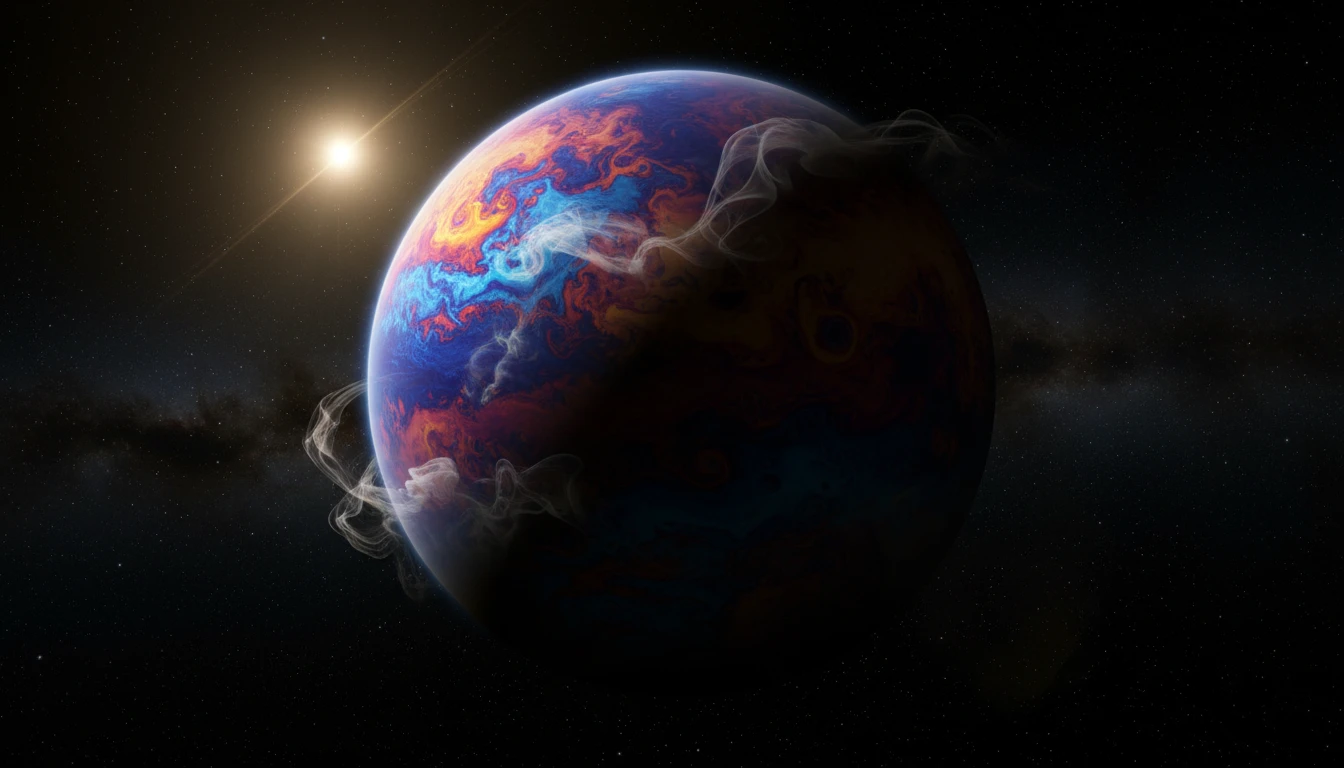
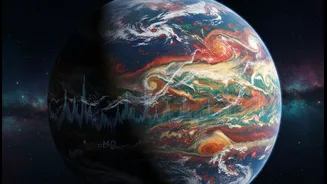
It seems strange to begin the search for water on planets like Jupiter or Neptune, which are mostly swirling gas and have no solid surface. But there is a very practical reason. Gas giants, especially those known as “hot Jupiters” that orbit very close to their stars, have huge, puffy atmospheres. Compared to a small, rocky planet like Earth, their atmospheres are vastly larger and less dense. When a gas giant transits its star, its thick, expansive atmosphere blocks more light and creates a much stronger, clearer spectral signal. It's the difference between trying to read tiny print in a dim room versus a giant, well-lit billboard. These massive planets provide an easier target for scientists to test and perfect their detection techniques before moving on to more difficult cases.
From Vapour to a Full Cycle
Identifying vapour is just the first step. By repeatedly observing a planet as it rotates, astronomers can map how these water vapour tracks change over time and geography. This allows them to build a picture of the planet’s weather. They can see where water is more concentrated, how it’s moved by powerful winds between the scorching dayside and cooler nightside, and how it might interact with other chemicals in the atmosphere. This complex interplay of movement and chemical reaction is, in essence, the planet’s water cycle. Understanding how these cycles work on gas giants provides the fundamental models needed to interpret the much fainter signs we might one day see from a rocky, Earth-like world.
The Ultimate Goal: A Second Earth
The knowledge gained from studying gas giants is not just for understanding those planets alone. It is a critical stepping stone. Every technique refined and every atmospheric model built using data from these easier targets prepares astronomers for the ultimate prize: analysing the thin wisp of atmosphere around a rocky planet in the habitable zone. These worlds, similar in size to our own, are much harder to study, but they hold the greatest promise for finding liquid water oceans and, just maybe, signs of life. The search for water on remote gas giants is not the final destination; it is the essential groundwork for one of humanity’s most profound quests.