



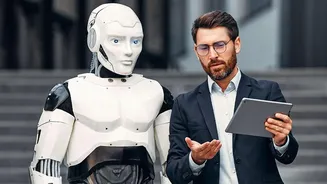
The rise of artificial intelligence is sparking conversations about productivity and job replacement. But a more subtle, critical challenge is emerging: the very nature of entry-level work is changing, and with it, the way we build future talent.
The Automation of the Learning Curve
For decades,
the first rung on the career ladder was built from routine, often tedious, tasks. Junior employees drafted reports, cleaned data, reviewed documents, and handled basic research. While not glamorous, this work served a vital purpose: it was a real-world training ground. It provided the hands-on practice needed to develop foundational skills, pattern recognition, and professional judgment. Now, generative AI is capable of automating many of these starter tasks with remarkable speed. This shift is creating an 'experience gap'. If the basic work that once served as a professional apprenticeship disappears, it raises a critical question: how will the next generation learn the ropes?
A Growing Skills and Mentorship Deficit
When AI handles the first draft, the role of a junior employee can shift from 'creator' to 'reviewer'. While this may increase efficiency, it risks creating a workforce that is proficient at editing AI outputs but lacks the deep understanding that comes from building something from scratch. This can hollow out a company's talent pipeline, leaving a shortage of truly experienced professionals down the road. The problem is compounded by a potential mentorship deficit. With less need to delegate foundational tasks, senior employees may have fewer organic opportunities to coach and guide their junior counterparts. This erodes the informal, by-osmosis learning that happens when experienced and new colleagues work closely together on fundamental problems.
Redefining 'Support' for a New Era
Supporting entry-level careers in the age of AI isn't about resisting automation, but about being more intentional with talent development. Companies must actively redesign how skills are acquired. This means creating new mechanisms for learning that replace the lost practice opportunities. Some firms are exploring structured simulations, AI-assisted coaching tools, and deliberate 'escalation drills' where juniors must handle problems without AI assistance to test their judgment. The focus is shifting toward durable, uniquely human skills: critical thinking, complex problem-solving, creativity, and emotional intelligence. These are the capabilities AI can augment but not replicate, and they are best cultivated through deliberate human interaction and mentorship.
The New Responsibilities for Employers and Employees
Navigating this new landscape requires a shared commitment. Employers can no longer assume that crucial skills will be absorbed passively. They must invest in structured mentoring programs, moving beyond informal connections to ensure equitable access to guidance. This includes creating opportunities for 'reverse mentorship', where digitally native junior employees can help senior leaders understand emerging technologies. For their part, early career professionals must become proactive learners. This means seeking to understand the 'why' behind the tasks AI performs, asking for feedback, and actively building relationships with experienced colleagues. Adaptability and a willingness to learn how to work alongside AI will be key to long term career success.