


Meet NASA's Next Great Observatory
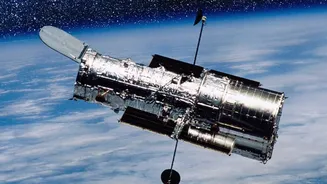
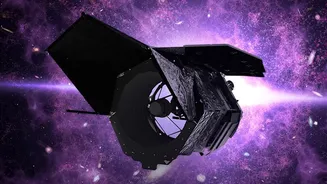
Set to launch as early as August 2026, the Nancy Grace Roman Space Telescope is NASA's next flagship observatory, joining the ranks of titans like the Hubble and James Webb Space Telescopes. Named after NASA's first chief of astronomy, Nancy Grace Roman,
who was instrumental in the creation of the Hubble program, this new observatory has a very specific and powerful mission. Its primary goals are twofold: to hunt for exoplanets and to unravel the mysteries of dark energy, the enigmatic force accelerating the universe's expansion. While its mirror is the same size as Hubble's, Roman's true strength lies in its incredible field of view. Its Wide Field Instrument will be able to capture an area of the sky 100 times larger than Hubble can in a single snapshot, making it a survey telescope of unprecedented power. This means that in the time it would take Hubble to photograph two individual stars, Roman could map an entire star cluster.
A Trick of Spacetime
So how will Roman find so many new worlds? While it can use the traditional "transit method"—watching for the tell-tale dimming of a star as a planet passes in front of it—its real superpower is a technique called gravitational microlensing. This method relies on a phenomenon predicted by Einstein's theory of general relativity. When a star with a planet passes in front of a more distant star, its gravity acts like a lens, bending and magnifying the background star's light. The planet's own gravity creates a distinct, additional blip in this magnification, revealing its presence, mass, and orbit. This technique is especially powerful because it can find planets of all sizes, from gas giants down to worlds smaller than Mars, and it works for planets that are much farther from their star than methods like the transit method can typically detect.
A Wider, Deeper Census
The microlensing method will allow Roman to conduct a comprehensive galactic census of planets. Previous planet-hunting missions, like Kepler and TESS, have been incredibly successful but have largely focused on stars in our immediate cosmic neighborhood. Roman will stare deep into the crowded heart of the Milky Way, observing hundreds of millions of stars. This will provide a massive new dataset, allowing scientists to understand how planet formation might differ in the dense, element-rich center of the galaxy compared to our quieter suburban-like spiral arm. Some projections suggest Roman could find around 1,400 Earth-mass planets and potentially up to 100,000 exoplanets in total through its combined methods, a staggering number that would dwarf the roughly 6,300 exoplanets confirmed to date.
The Hunt for Rogue Worlds
Perhaps most exciting is Roman's ability to find planets that other methods are completely blind to: rogue planets. These are worlds that are not gravitationally bound to any star and drift alone through the darkness of interstellar space. Scientists believe there could be billions or even trillions of these orphaned worlds in our galaxy, ejected from their home systems during their chaotic formation. Because microlensing relies only on the mass of the lensing object, it can detect these dark, isolated planets as they drift in front of a distant star. Roman is expected to find hundreds of these rogue worlds, from Mars-sized rocky bodies to gas giants, providing our very first statistical look at this mysterious population of planets.
A Complement to Webb and Hubble
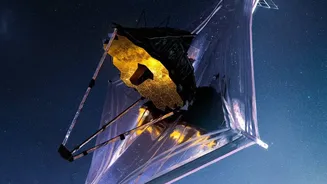
Roman will not replace its famous predecessors but work in tandem with them. It is best understood as a giant finder scope. With its vast survey capabilities, Roman will identify tens of thousands of interesting targets—unique planetary systems, rare rogue planets, and more. Then, observatories like the James Webb Space Telescope, with its narrow but incredibly deep vision and ability to analyze atmospheric composition, can perform detailed follow-up studies on the most promising worlds Roman discovers. While Roman finds the crowd, Webb will be able to zoom in on the most interesting individuals. This powerful synergy will define the next era of astrophysics, allowing scientists to not only count the planets in our galaxy but to begin understanding their true nature.