



Seeing the Universe in a New Light
Imagine you could see heat. The warm glow from a cooling oven, the faint heat signature of footsteps on a carpet—this is the world of infrared. It is a spectrum of light with a longer wavelength than the red light our eyes can perceive. In space, this ability
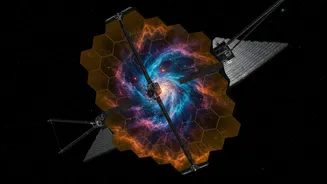
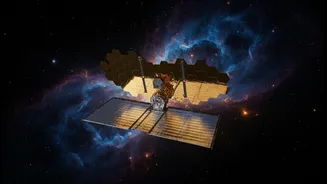
to 'see' heat and peer through otherwise opaque cosmic dust is revolutionary. Much of the universe is filled with cool objects like planets, asteroids, and vast molecular clouds that don't shine brightly in visible light. They do, however, emit faint heat signatures in the infrared. Furthermore, thick curtains of interstellar dust block visible light from reaching us, hiding cosmic events like the birth of stars. But because of its longer wavelength, infrared light can pass through this dust largely unhindered, allowing telescopes like the James Webb Space Telescope (JWST) to see what optical telescopes like Hubble cannot.
Inside Cosmic Nurseries
One of the most profound applications of infrared astronomy is its ability to look directly into stellar nurseries. These are gigantic, dense clouds of gas and dust where stars are born. To visible light telescopes, these regions appear as dark, impenetrable voids. But for an infrared instrument, they are bustling maternity wards. By looking in the infrared, astronomers can watch protostars, the precursors to full-fledged stars, begin to glow within their dusty cocoons. Recent observations using the JWST have provided unprecedented detail about this process, revealing how massive star clusters emerge from their natal clouds, clearing away gas and influencing the evolution of their host galaxies. These studies show that more massive clusters form faster, a key insight into how galaxies build themselves over cosmic time. It's like having an ultrasound for the cosmos, watching the very first moments of a star's life.
A Glimpse of Alien Atmospheres
Infrared light is also a crucial tool in the search for life beyond Earth. When a planet passes in front of its host star, a tiny fraction of the starlight filters through the planet's atmosphere. By capturing this light in the infrared and analysing it—a technique called spectroscopy—scientists can identify the chemical fingerprints of different molecules. This allows them to effectively 'taste' the air of distant worlds. Instruments on the JWST can detect gases like water vapour, methane, and carbon dioxide, all potential indicators of a planet's habitability. In a recent study published in July 2026, astronomers used Webb to study a Jupiter-sized planet orbiting a dead star called a white dwarf. The infrared observations not only measured the planet's temperature but also detected its atmosphere, providing a glimpse into the far-future of planets after their stars die.
Looking Back to the Dawn of Time
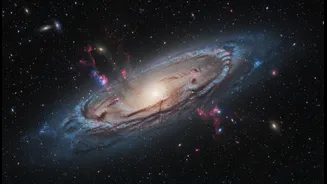
Because light takes time to travel across the vastness of space, looking at distant objects is like looking back in time. The most distant galaxies are so far away that their light has traveled for over 13 billion years to reach us. Due to the expansion of the universe, this light gets stretched out, shifting it from the visible and ultraviolet spectrum into the infrared—a phenomenon known as cosmological redshift. This is why the JWST was primarily built as an infrared telescope: to capture this ancient light from the universe's infancy. Since it began operations, Webb has been discovering galaxies that are brighter and more complex than theories predicted, and black holes that appear too massive for their age. These findings are challenging and refining our models of how the first stars and galaxies formed after the Big Bang, rewriting the earliest chapters of cosmic history.