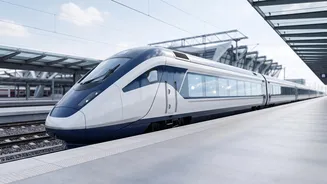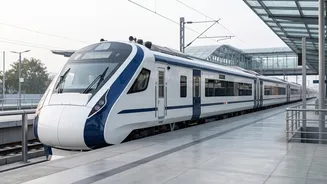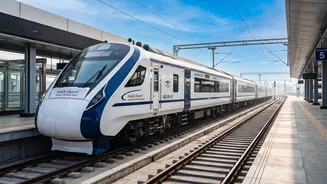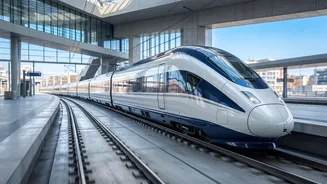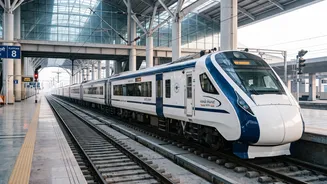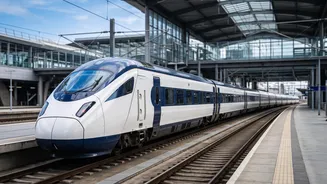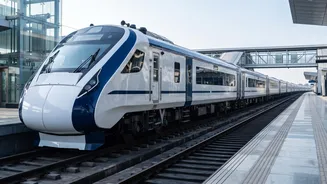








The Vande Bharat Express has already redefined daytime travel in India. Now, Indian Railways is taking the next big leap by developing a longer, 24-coach sleeper version, promising to revolutionise the nation's overnight journey experience.
A New Chapter in Overnight Travel
Since its debut
in 2019, the Vande Bharat Express has become synonymous with speed, comfort, and modern train travel for daytime journeys. However, the next phase of its evolution is focused on conquering the night. Indian Railways is actively developing a new sleeper variant of the Vande Bharat, designed specifically for long-distance overnight routes. The first 16-coach sleeper train was already introduced in January 2026. Now, the focus is on an even bigger version: a 24-coach trainset that aims to offer a premium alternative to established names like the Rajdhani Express, combining the Vande Bharat's speed with the comfort required for a good night's rest.
More Coaches, More Comfort, More Capacity
The most significant upgrade in the new design is its length. Expanding from the current 16-coach configuration to 24 coaches allows for a substantial increase in passenger capacity, catering to high-demand routes. These new trains, set to be manufactured by the Integral Coach Factory (ICF) in Chennai, are part of a plan to roll out 50 such high-capacity sets. Unlike the chair cars of the original Vande Bharat, these coaches will feature three classes of sleeper berths: AC First Class, AC 2-Tier, and AC 3-Tier. This expansion is not just about adding more seats; it's about creating a more comprehensive travel solution for overnight journeys, complete with dedicated amenities to handle the larger passenger load.
Inside the New Sleeper: What to Expect
The passenger experience is at the heart of the new design. The berths are engineered to be better cushioned than those in existing sleeper trains. Each passenger will have access to individual reading lights and charging points. A major addition in the 24-coach version is a dedicated pantry car, allowing for hot meals to be prepared and served onboard, a feature distinct from the 16-coach prototype. The coaches will also feature modern bio-vacuum toilets similar to those in aircraft, including some with baby-care stations. For those travelling in AC First Class, a hot water shower facility will be available. Sealed gangways between coaches will reduce noise and dust, while automatic doors will enhance safety and convenience.
The Rajdhani Rivalry Heats Up
The introduction of the Vande Bharat sleeper sets it up as a direct competitor to the Rajdhani Express, the longstanding benchmark for premium overnight travel in India. The key advantage for the Vande Bharat lies in its distributed power system, which allows for faster acceleration and deceleration, potentially reducing overall journey times. For example, the proposed Delhi–Varanasi Vande Bharat sleeper is projected to complete its journey in about 9.2 hours, compared to the Rajdhani's 12 hours. While Rajdhani has a wellestablished and extensive regional menu system, the Vande Bharat aims to offer routespecific culinary options. With its modern interiors, advanced safety features like KAVACH, and superior ride quality, the Vande Bharat sleeper is poised to challenge the Rajdhani's dominance.
Manufacturing and Rollout Timeline
The ambitious plan to modernise India's sleeper train fleet involves multiple players. While ICF Chennai is tasked with producing 50 of the 24coach trainsets, other consortia are also heavily involved in manufacturing 16coach versions. BEML is producing ten trainsets, an IndoRussian joint venture (Kinet) is building 120, and a consortium of Titagarh Rail Systems and BHEL is responsible for another 80. The design for the 24coach version is expected to be finalised by November 2026, with a prototype targeted for completion by mid–2027. While recent approvals have been granted for $16$-coach sleeper services on routes like Delhi–Varanasi and Mumbai–Bengaluru,$the larger $24$-coach trains are anticipated to enter service starting June $20$7,$ marking a significant capacity boost for the network.