


The Final Eight-Minute Sprint
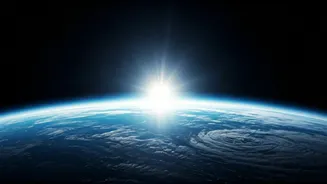
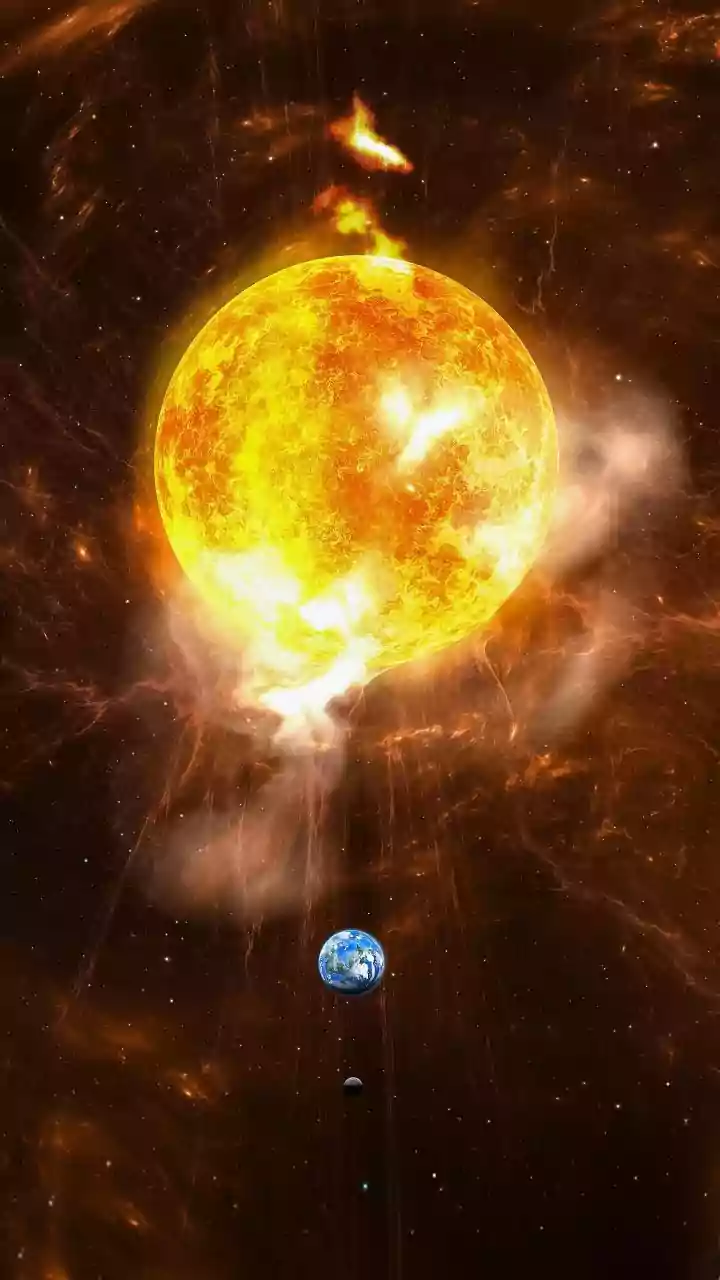
Let’s start with the part of the journey you probably know. The Sun is about 150 million kilometres away from Earth. Light, the fastest thing in the universe, travels at an incredible speed of nearly 300,000 kilometres per second. A quick calculation
tells us that it takes light approximately 8 minutes and 20 seconds to travel from the surface of the Sun to us here on Earth. This means that if the Sun were to suddenly vanish, we wouldn't know about it for over eight minutes. We’d still see it shining in the sky, a ghostly echo of a star that was no longer there. This delay is a mind-bending concept in itself, turning every sunrise into a glimpse of the very recent past. But this eight-minute dash through the vacuum of space is only the final, triumphant lap of a journey that is unimaginably longer and more arduous.
The Journey Before the Journey
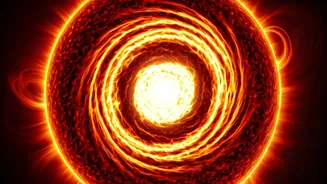
The real story of your sunlight begins not on the Sun’s fiery surface, but deep within its core. This is where the magic of nuclear fusion happens. Under immense pressure and at temperatures of around 15 million degrees Celsius, hydrogen atoms are fused together to create helium. A byproduct of this monumental reaction is a burst of energy in the form of a high-energy photon — a particle of light. This newborn photon is ready to begin its journey to the surface. You might think, given the Sun's radius of about 700,000 kilometres, this would be a quick trip. But you would be wrong. The photon has just been born into one of the most chaotic environments in the solar system.
A Million-Year Traffic Jam
The Sun's interior is not empty space; it's a super-dense soup of plasma, packed with charged particles. Our brand-new photon can't just fly straight out. In fact, it can barely travel a fraction of a millimetre before it collides with an atom, gets absorbed, and is then re-emitted in a completely random direction. It might go sideways, backwards, or slightly forwards. It never travels in a straight line for long. Physicists call this process a “random walk.” Imagine trying to leave a ridiculously crowded room by taking one tiny step in a random direction every second. You’d spend ages just zigzagging around, often ending up right back where you started. For a photon inside the Sun, this process is repeated trillions upon trillions of times. The path from the core to the surface is not a straight line but a torturous, billion-kilometre-long stumble.
So, How Old Is That Sunlight?
Because the path is so random, there is no single answer to how long this journey takes. Scientists' estimates vary widely, from a “short” 10,000 years to over a million years. The most commonly cited average is around 100,000 to 200,000 years. This means the energy in the light warming your face was likely created in the Sun’s core when early humans were first migrating out of Africa, long before recorded history, agriculture, or civilization as we know it. Every time the photon is absorbed and re-emitted, it also loses a bit of energy. It starts as a high-energy gamma ray in the core and, by the time it finally breaks free from the surface, has transformed into the lower-energy visible light and heat that sustains life on Earth. The eight-minute journey through space is merely the final, peaceful leg of an ancient, chaotic odyssey.