




The Great Celestial Junkyard
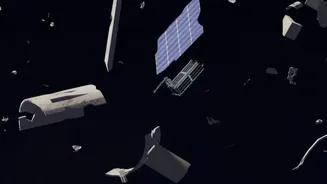
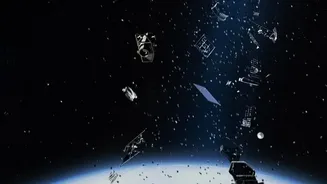
Since the space age began in 1957, humanity has been incredibly successful at sending things up, but not so good at bringing them down. There are now millions of pieces of 'space junk' in orbit. This includes over 30,000 objects larger than a softball
that are actively tracked, but also an estimated 1.2 million pieces between 1 and 10 cm. Even a tiny paint fleck, travelling at 28,000 km/h, can hit with the force of a hand grenade, capable of disabling a critical weather or communications satellite. The bigger concern is a cascade event known as the Kessler Syndrome, where a single collision creates a cloud of new debris, which in turn causes more collisions, potentially rendering entire orbital altitudes unusable for centuries.
Harpoons: To Catch a Tumbling Satellite
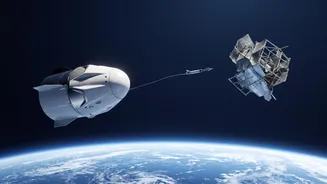
One of the most direct solutions being tested is exactly what it sounds like: a space harpoon. Missions like the one tested by the Surrey Space Centre have demonstrated that it's possible to fire a barbed projectile into a target panel representative of a satellite's skin. The harpoon would be tethered to a 'chaser' spacecraft, allowing it to secure the rogue object. This method is effective for capturing large, tumbling pieces of debris that might be too unpredictable for a delicate robotic arm. The challenge is immense, requiring precise targeting of an object that could be spinning uncontrollably, but successful tests have proven the concept is viable for active debris removal.
Nets and Claws: A Gentler Approach
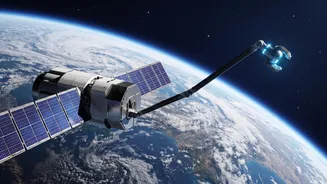
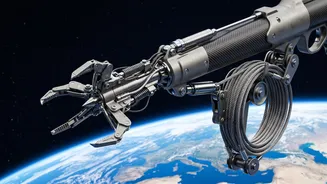
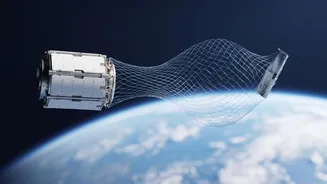
Not all debris can be skewered. For more delicate captures or irregularly shaped objects, space agencies are turning to nets and robotic claws. The RemoveDEBRIS mission also successfully demonstrated casting a net in orbit to capture a target. A chaser satellite would deploy a large net that envelops the junk, after which the entire package can be dragged into a lower orbit to burn up in the atmosphere. Similarly, the European Space Agency's ClearSpace-1 mission, planned for 2028, will use a four-armed robotic 'claw' to grab a defunct satellite. The original target was changed after it was likely hit by a small piece of debris itself, ironically highlighting the urgency of these missions.
Lasers and Magnets: The Contactless Cleanup
Some of the most futuristic methods avoid physical contact altogether. Ground-based lasers could be used to gently nudge debris, not by vaporizing it, but by creating a tiny puff of plasma on its surface that alters its trajectory just enough to avoid a collision or speed up its orbital decay. Another approach involves magnetism. While most debris is not magnetic, many satellites have components that are. Companies like Japan's Astroscale are pioneering technology to use powerful electromagnets to attract and dock with specially designed plates on future satellites, making end-of-life cleanup a planned part of a satellite's lifecycle. Astroscale has already run successful missions demonstrating the ability to approach and inspect debris in orbit.
The Business of a Cleaner Orbit
Cleaning up space is rapidly becoming a serious business. With the proliferation of satellite mega-constellations from companies like SpaceX, the orbital environment is more crowded than ever. This has created a commercial market for 'in-orbit servicing', valued in the hundreds of millions and expected to grow exponentially. Companies like Astroscale, ClearSpace, and Kall Morris Inc. are leading the charge, developing these technologies not just as experiments, but as commercial services for satellite operators who need to protect their billion-dollar assets. Government agencies like NASA and ESA are actively funding these startups, signalling a shift from a theoretical problem to an operational necessity.