





A Junkyard Above Our Heads
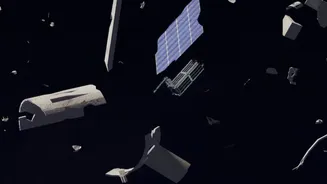
Low Earth Orbit (LEO) has become increasingly crowded. Decades of launches have left behind a trail of artificial objects, from spent rocket stages and dead satellites to tiny fragments from collisions and explosions. This collection of human-made objects is collectively
known as space debris or space junk. The U.S. Space Surveillance Network tracks more than 27,000 pieces of debris larger than a softball, but there are millions of smaller pieces that are too small to be individually tracked. Travelling at speeds of around 7.8 kilometres per second in LEO, even a centimetre-sized fragment carries enormous kinetic energy and can cause catastrophic damage to active satellites, which we rely on for GPS, communications, and weather forecasting. This makes identifying and tracking every object a critical task for space situational awareness (SSA).
The Telltale Signature of Light
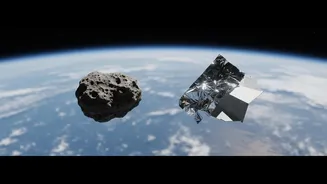
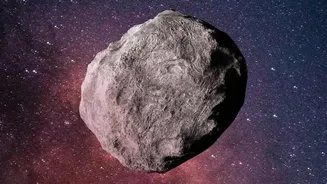
One of the key methods for identifying an object is analysing its light curve—a graph of its brightness over time. As an object tumbles through space, the amount of sunlight it reflects toward a telescope changes. A natural space rock, or meteoroid, is typically an irregular chunk of stone and metal, so it tumbles in a complex way, creating an erratic and unique light curve. In contrast, artificial debris often has more uniform shapes, like the cylindrical body of a rocket or the flat panels of a satellite. This leads to more regular, repeating patterns of brightness as they spin or rotate. Researchers can analyse these light patterns to infer an object's shape, size, and even its rotation, helping to distinguish a man-made cylinder from a lumpy asteroid.
Decoding an Object's DNA
Beyond just how much light an object reflects, scientists can analyse the light itself. This technique, called spectroscopy, splits the reflected sunlight into its component colours, creating a spectrum. This spectrum acts like a material fingerprint. Asteroids and other natural rocks are made of specific minerals and elements, which absorb and reflect sunlight in characteristic ways, leaving distinct spectral signatures. Artificial debris, on the other hand, is made from materials like aluminium, steel, solar panel composites, and specialised paints. These materials produce a completely different spectrum. For example, a study of an object named 2020 SO used spectroscopy to confirm it wasn't an asteroid, but a discarded rocket booster from a 1966 mission, based on the signature of its stainless steel and paint.
The Path It Travels
An object's trajectory is another major clue. Most space junk is in a predictable orbit around the Earth, following paths established when it was launched. These objects, known as Resident Space Objects (RSOs), are confined to Earth-centric orbits, from LEO to the high-altitude geostationary (GEO) belt. Natural space rocks, however, are typically in orbit around the Sun. They are just passing through Earth's neighbourhood. Their trajectories are often faster and can come from any direction, sometimes at steep angles relative to Earth. Debris, by contrast, tends to have a shallower angle of entry if it de-orbits and is more likely to travel west-to-east, following common launch paths. By analysing an object's orbital elements—its speed, altitude, and inclination—researchers can determine if its path is consistent with an Earth-orbiting satellite or a visitor from deep space.
The Tools of the Trade
Identifying these objects requires a global network of powerful sensors. Ground-based radars are primarily used to track objects in lower orbits, while optical telescopes are better suited for the higher geostationary orbits. Radars work by bouncing radio waves off an object and analysing the return signal. The strength and nature of this echo, known as the Radar Cross-Section (RCS), can reveal an object's size and shape. The U.S. Space Surveillance Network and other international systems use these tools to maintain a vast catalogue of space objects. Increasingly, machine learning and AI algorithms are being employed to sift through the massive amounts of data from light curves and radar returns, helping to classify objects with greater speed and accuracy.