



The Classic Recipe for a Planet
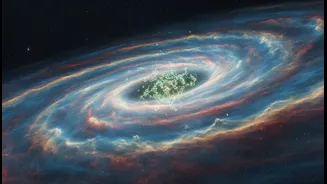
For decades, the leading theory for how planets form has been a tidy, step-by-step process called 'core accretion'. Think of it as a cosmic snowball effect. It all starts with a young star surrounded by a vast, spinning disc of gas and dust. In this disc,
tiny dust grains start sticking together, first through static electricity, then through gravity. Over millions of years, these clumps grow from pebbles to boulders, then to 'planetesimals'—rocky bodies kilometres across. Eventually, a few of these grow massive enough to form a solid core. If this core becomes about ten times the mass of Earth, its gravity is strong enough to rapidly pull in huge amounts of gas from the surrounding disc, creating a gas giant like Jupiter or Saturn. This bottom-up process neatly explains the planets in our own solar system, with rocky worlds close to the Sun and gas giants farther out.
A Puzzle in the Outer Reaches
But as telescopes became more powerful, astronomers started finding planets that just didn’t fit the mould. They discovered enormous gas giants, many times the mass of Jupiter, orbiting their stars at incredible distances—sometimes hundreds of times farther than Jupiter orbits our Sun. According to the core accretion model, this shouldn't be possible. At such vast distances, the protoplanetary disc of gas and dust is far too thin and sparse. There simply isn't enough raw material, and the orbital periods are too long, for a rocky core to form and then capture a massive atmosphere within the few-million-year lifespan of the disc. These distant giants posed a major challenge, suggesting that nature has more than one way to build a world.
An Alternate Theory: Gravitational Instability
This puzzle led to a revival of an alternative, more dramatic theory: 'disk instability' or 'gravitational instability'. This is a top-down approach. Instead of a slow build-up, it proposes that under certain conditions, the protoplanetary disk itself can become massive and unstable. Parts of the disc can rapidly cool and collapse under their own gravity, forming huge, planet-sized clumps of gas and dust in as little as a few thousand years—a cosmic blink of an eye compared to the millions required for core accretion. This process is much better at explaining the formation of massive planets at very large orbits, where core accretion struggles. It’s less like building a snowball and more like a massive cosmic snowplough creating a pile all at once.
New Evidence from Distant Worlds
Recent observations, particularly from advanced observatories like the Atacama Large Millimeter/submillimeter Array (ALMA) and the James Webb Space Telescope (JWST), have provided compelling evidence for the disk instability model. By studying the young star system AB Aurigae, about 530 light-years away, astronomers detected distinct 'wiggles' in the motion of the gas in its surrounding disk. These kinematic signals perfectly matched the predictions of a disk that is gravitationally unstable and collapsing to form planets directly. Similarly, analysis of the atmosphere of giant planets in the HR 8799 system, using JWST, helps scientists probe their chemical makeup. The composition of these planets can hold clues as to whether they formed via core accretion, by gathering up solid materials, or through direct gravitational collapse of gas.
Two Paths to Building a Planet
The latest findings don't necessarily mean the core accretion model is wrong. Instead, they suggest that planet formation isn't a one-size-fits-all process. It's likely that both mechanisms are at play across the galaxy, operating under different conditions. Core accretion may be the dominant method for forming planets closer to a star, including rocky worlds like Earth and closer-in gas giants. Disk instability, on the other hand, appears to be a viable and efficient way to form the super-massive planets we see in the far-flung outer reaches of planetary systems. The universe, it seems, has at least two major pathways for creation. Discoveries of unusual systems, like one with a rocky planet orbiting farther out than its gas giants, continue to challenge and refine these models.