
First, What Is a Lunar Eclipse?
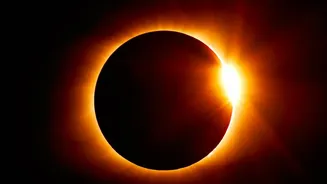
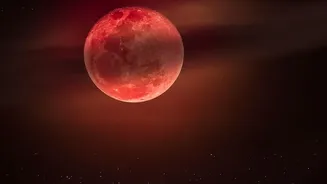
A lunar eclipse happens when the Sun, Earth, and Moon align perfectly, with Earth positioned directly in the middle. This alignment causes Earth to cast a large shadow onto the Moon, which shines not by its own light, but by reflecting sunlight. You might
expect the Moon to simply vanish into darkness when it enters Earth's shadow, known as the umbra. If our planet had no atmosphere, that’s exactly what would happen—the Moon would become almost invisible. But instead, something far more spectacular occurs, thanks to the thin blanket of air surrounding our world.
Earth's Atmosphere as a Giant Lens
The secret to the Moon's reddish glow lies entirely with Earth's atmosphere. This layer of gas, dust, and water vapour extends about 80 kilometres above our planet's surface. As sunlight streams past Earth, it doesn't just get blocked; it passes through this atmospheric ring. The atmosphere acts like a giant, imperfect lens, bending or refracting the light that grazes its edges. This bent light is then redirected into Earth's shadow, faintly illuminating the lunar surface even when it's fully eclipsed. Without this bending of light, the Moon would go completely dark.
The Science of Scattered Sunlight
So, if sunlight is being bent towards the Moon, why does it turn red? The answer is a process called Rayleigh scattering. Sunlight might look white, but it's actually a spectrum of different colours, from violet and blue on one end to orange and red on the other. Each colour travels at a different wavelength. Blue and violet light have shorter wavelengths, which are easily scattered in all directions by the gas molecules in Earth's atmosphere. This is the very reason our sky appears blue during the day. Red and orange light, however, have longer wavelengths. They are less likely to be scattered and can travel more directly through the atmosphere.
A Projection of a Million Sunsets
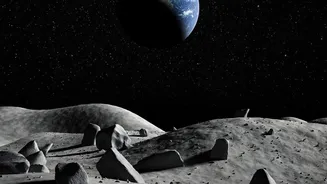
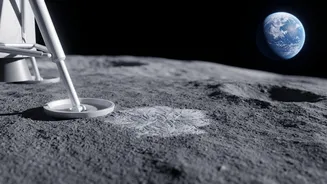
During a total lunar eclipse, the sunlight that reaches the Moon has had to travel through the thickest part of Earth's atmosphere—the air along the planet's edge, or limb. By the time it gets through, most of the blue light has been scattered away, leaving primarily the reddish portion of the spectrum. This filtered, reddish light is what gets bent onto the Moon. In a sense, what you are seeing on the eclipsed Moon is the combined glow of every single sunrise and sunset happening on Earth at that exact moment, projected onto the lunar surface. If you were an astronaut standing on the Moon during the eclipse, you would see Earth as a dark disc with a brilliant red ring around it.
Why Every Eclipse Looks Different
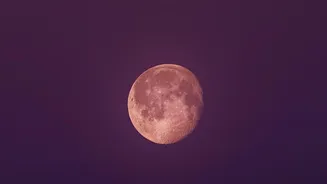
Not all lunar eclipses are the same shade of red. The exact colour and brightness can range from a bright copper-orange to a deep, dusky brown that is almost invisible. This variation depends entirely on the state of Earth's atmosphere at the time of the eclipse. A cleaner, drier atmosphere allows more light to pass through, resulting in a brighter, more orange moon. However, if the atmosphere is filled with more clouds, dust, or even volcanic ash, it will block more light. This can make the moon appear a much deeper, darker shade of red, or in extreme cases, almost black. This atmospheric connection makes every single lunar eclipse a unique snapshot of our own planet's air.