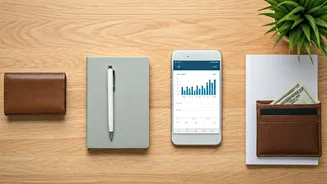









First, Decode Your Salary Slip
That first payslip can be confusing. Your Cost-to-Company (CTC) is not your in-hand salary. A payslip breaks down your earnings (Basic, HRA, allowances) and deductions (Provident Fund, Professional Tax, TDS). [23, 25] The basic salary is the fixed, core
component and is fully taxable. It's crucial because it's used to calculate other elements like your Provident Fund (PF) and House Rent Allowance (HRA). [26, 27] Your Employee's Provident Fund (EPF) is a mandatory retirement saving where 12% of your basic salary is deducted, and your employer contributes an equal amount. [26] Understanding these components helps you know exactly where your money is going and forms the basis of all your financial planning. [25, 21]
The Old vs. New Tax Regime Puzzle
As a new earner, you must choose between two tax systems: the old and the new. The new tax regime is now the default option and offers lower tax rates but removes most deductions like those under Section 80C. [19, 15] This regime is often beneficial for young professionals with fewer investments, as income up to ₹12 lakh can be effectively tax-free due to rebates. [6, 22] The old regime has higher tax rates but allows you to claim deductions for investments (like EPF, PPF, ELSS), HRA, and home loan interest. [14, 22] If you plan on making significant tax-saving investments, the old regime might save you more money. [14] It's crucial to calculate which regime is better for your specific income and investment habits. [19]
Start a SIP: Your Best Friend for Wealth Creation
A Systematic Investment Plan (SIP) is a way to invest a fixed amount of money regularly in mutual funds. [3, 18] It's the perfect entry point into investing for beginners. You can start a SIP with as little as ₹500 a month through various fintech apps. [3, 16] The process is simple: complete your one-time KYC (Know Your Customer) with your PAN and Aadhaar, choose a fund, and set up an automatic debit from your bank account. [3, 7] For long-term goals (5+ years), consider an equity index fund. [3] The power of SIPs lies in rupee cost averaging (buying more units when prices are low and fewer when high) and compounding, which helps your small, regular investments grow into a significant corpus over time. [18, 20]
Build Your Financial 'Report Card': The Credit Score
Your credit score (like a CIBIL score) is a three-digit number between 300 and 900 that represents your creditworthiness. [6] Think of it as your financial reputation. [2] Lenders use this score to decide whether to approve loans or credit cards. A score of 750 or above is considered excellent and can get you faster loan approvals, lower interest rates, and higher credit limits. [2, 11, 13] As a young earner with no credit history, you can start building your score by getting a basic credit card, using it for small purchases, and—most importantly—paying the full bill on time, every time. [6] Never missing a payment is the golden rule for maintaining a healthy credit score. [2]
The Emergency Fund: Your Financial Safety Net
Life is unpredictable. A sudden job loss, medical issue, or family crisis can throw your finances into chaos. [29] An emergency fund is a pool of money set aside specifically for these unexpected shocks. [29, 31] The general rule is to have enough to cover 3 to 6 months of your essential living expenses (rent, food, EMIs, utilities). [30] Start small by automating a transfer to a separate savings account each month, right after you get your salary. [29, 30] Treat it like an EMI you can't miss. Even ₹5,000 a month adds up. Once you have a decent sum, you can move part of it to a liquid mutual fund, which offers slightly better returns than a savings account and can be accessed quickly. [29, 30]