


Meet Pushpak: India's Space Shuttle
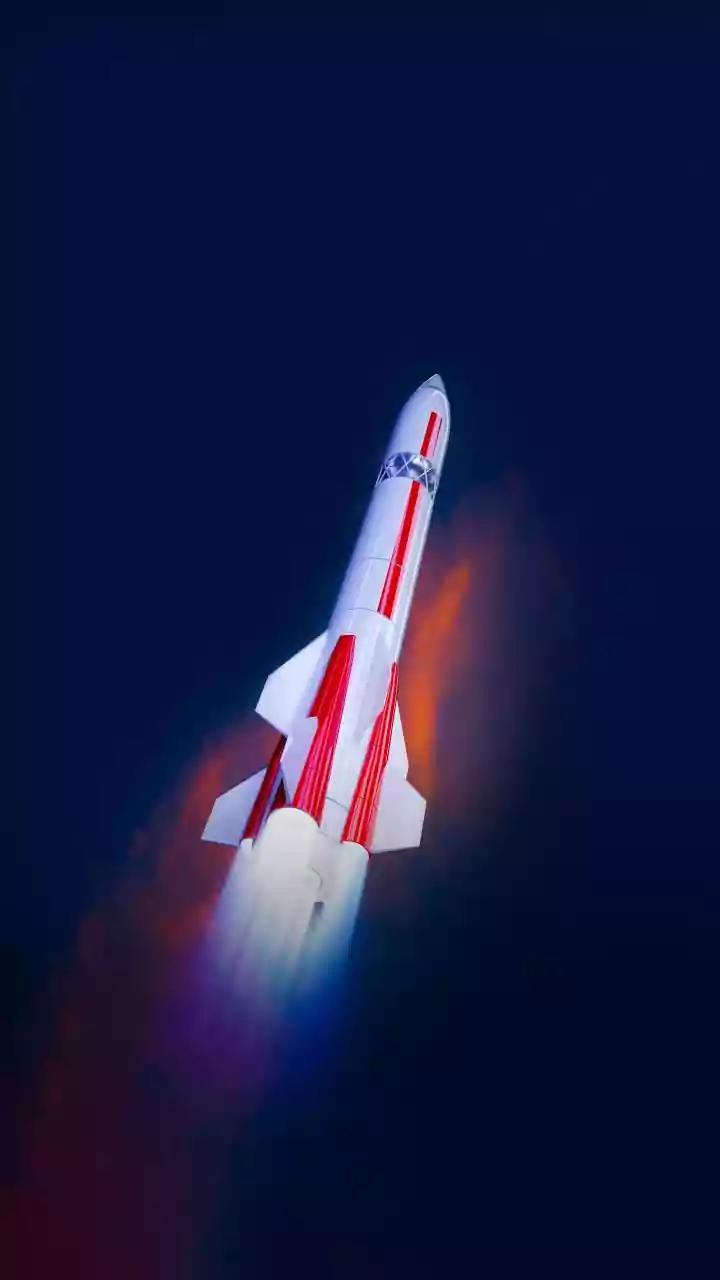
The star of the show is ISRO's Reusable Launch Vehicle (RLV), nicknamed 'Pushpak'. This uncrewed, winged vehicle is the centrepiece of a series of technology demonstration missions aimed at developing a fully reusable Two-Stage-to-Orbit (TSTO) launch
vehicle. Think of it as a space plane that can fly to space, deliver its payload, and then return to Earth, landing on a runway just like an aircraft. The recent tests, known as the Landing Experiment (LEX) series, have been focused on mastering the incredibly complex final phase of the mission: landing autonomously without any human pilot. Having successfully completed a hat-trick of these landing tests, ISRO has proven its expertise in this crucial technology.
The Genius of Autonomous Landing
The latest landing test was the most challenging yet. An Indian Air Force Chinook helicopter carried Pushpak to an altitude of 4.5 kilometres. From there, it was released to find its own way back to the runway. The vehicle had to autonomously handle significant course deviations and severe wind conditions. Using a sophisticated suite of sensors, including ISRO's own NavIC satellite navigation system, the vehicle executed precise manoeuvres to align with the runway and perform a perfect horizontal landing. Due to its aerodynamic design, Pushpak approached the runway at a blistering speed of over 320 kmph, significantly faster than a commercial airliner. After touchdown, a brake parachute and landing gear brakes brought it to a controlled stop, showcasing an advanced guidance and control system ready for future orbital missions.
Why Reusability is the Holy Grail
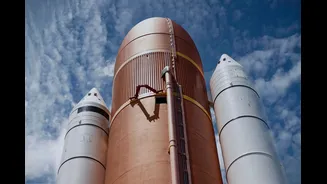
The primary motivation behind developing vehicles like Pushpak is simple: cost. Traditionally, rockets are expendable; their expensive components are discarded after a single use, which is like throwing away an airplane after just one flight. The most expensive parts of a rocket, including its engines and structural stages, can account for a huge portion of the total launch cost. By recovering and reusing these components, ISRO aims to slash the cost of delivering payloads to Low Earth Orbit by a factor of ten, from the current estimate of around $20,000 per kilogram to as low as $2,000 per kilogram. This dramatic cost reduction will not only make India's own space missions more affordable but will also make ISRO a highly competitive player in the multi-billion dollar global satellite launch market.
A Stepping Stone to Bigger Goals
The successful landing experiments are a vital part of a much larger plan. The RLV-TD programme is a series of tests designed to validate key technologies. Having completed the Hypersonic Flight Experiment (HEX) and now the Landing Experiments (LEX), ISRO is gaining invaluable data and experience. Impressively, the winged body and flight systems from the second landing test were reused for the third mission without modification, demonstrating the robustness of the design. This step-by-step approach builds confidence and capability for the next ambitious phase: the Orbital Re-entry Experiment (ORE). In this future mission, a vehicle like Pushpak will be launched into orbit on a rocket, spend time in space, and then de-orbit to perform an autonomous re-entry and landing.
The Road Ahead for India's Space Program
Mastering reusable launch technology is fundamental to India's long-term space strategy. It is a critical enabler for ambitious future projects, including the Gaganyaan human spaceflight mission, the establishment of the Bharatiya Antariksh Station (Indian Space Station), and deep-space exploration. While global players like SpaceX have already operationalised reusable rockets, ISRO's approach with a winged vehicle is a different, but equally valid, technological path. The success of the Pushpak tests signals that India is rapidly closing the gap and is on track to develop its own fully reusable, cost-effective launch system, cementing its position as a major global space power. The journey from these successful test landings to an operational TSTO vehicle will take time, but the foundation has been firmly and impressively laid.